If you have been thinking about booking a craft class but keep hesitating because you do not know what actually happens inside one, this guide is for you. Below is a chronological walk through a typical KraftStories workshop so nothing feels unfamiliar when you arrive.
Key Takeaways
Craft workshops are built for beginners. All materials and tools are provided, and no prior experience is needed. You do not need to bring your own supplies or know any techniques in advance.
You can come alone or with friends. Sessions are social but relaxed, and it is absolutely fine to be quiet or chatty.
You will make one finished project — a moss wall art piece, a candle, a tufted rug — to take home the same session. Some crafts may need extra drying time at home.
Instructors encourage experimentation rather than perfection. There is no test and no one is graded.
This post walks through a KraftStories craft workshop in order: before you arrive, the first few minutes, the demo, making your piece, finishing, and common FAQs.
Before You Book: Choosing the Right Craft Workshop
For most beginners, the hardest part is picking a class when craft terms feel unfamiliar. You might not know what Ebru means, or what a tufting gun does, and that is fine. You do not need to guess. Every workshop page on kraftstories.com tells you which craft you will make, whether the process is relaxed or detailed, what you take home, and whether it is offered in person or as a virtual session.
KraftStories offers moss and preserved-plant wall art, terrariums including aquatic terrariums, neon and moss wall art, wood burning (pyrography), Turkish mosaic lamps, Ebru Turkish paper marbling, air-dry clay, watercolor painting, tufting, and candle making.

When choosing your first workshop, think about your energy level. If you hope for something slow and meditative, Turkish paper marbling or watercolor painting may suit you. If you want a more active process, tufting or wood burning might be a better fit. Beginner workshops are designed to teach the basics from the ground up, so every class is built around beginners' skill levels.
Pricing varies by city and by workshop. Each workshop page at kraftstories.com shows the cost, so you can plan ahead without surprises. There are no hidden add-ons to buy on the day.
Before You Arrive: What to Wear, Bring, and Expect Logistically
The most common worry before a first class is "What do I need to bring?" At KraftStories, all materials and tools are included for in-person and virtual workshops. There is nothing to buy, nothing to prepare. You do not need your own brushes, pens, or supplies. If you want to bring a notebook or a drink, that is your choice.
For clothing, wear something comfortable you do not mind getting a bit of paint, wax, or plant debris on. Closed-toe shoes are helpful for workshops involving hot wax or sharp tools. Skip anything you would be upset to stain.
Minimum age for in-person workshops is 10, so adults can bring older kids or teens. The environment is still paced for an adult audience, but younger participants who meet the age requirement can follow along.
BYOB is welcome at our studios, so you are free to bring your own drink. Each workshop page confirms it for that location.
Before you walk in, double-check your confirmation email for the exact studio address and start time. Everything else is handled on our side, so you can simply sign up and show up.
The First Few Minutes: Walking Into the Studio
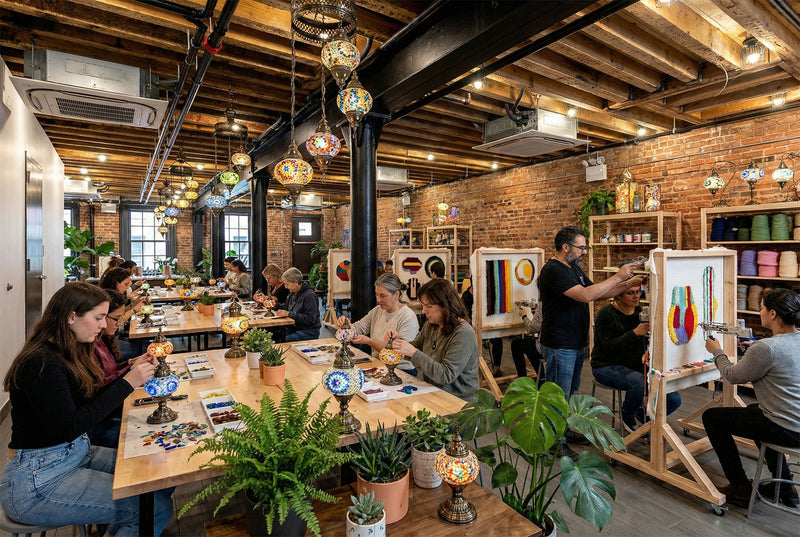
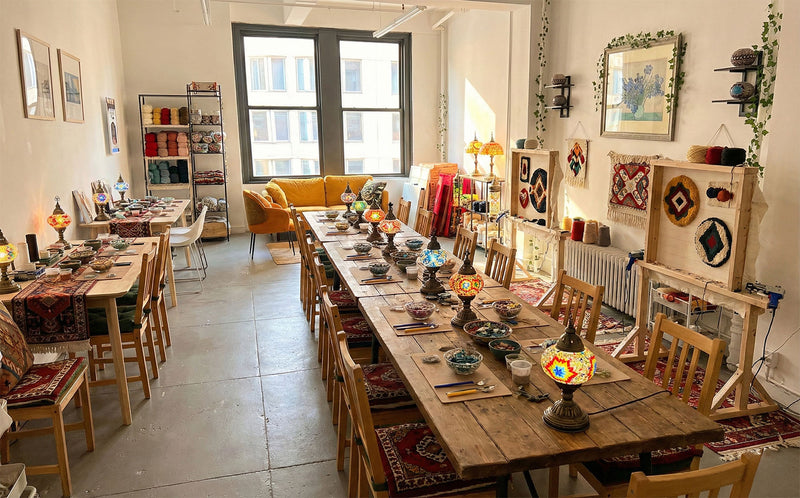
When you arrive at a KraftStories studio, the room will already be set up. Tables will have tools and materials neatly laid out at each station. You will not see bare folding tables with nothing on them; the space is prepared so you can sit down and feel oriented immediately.
Staff will greet you, confirm your name, and show you where to sit. If you came on your own, you will not be the odd one out. Seats typically hold a mix of couples on a date, friend groups, coworkers at a team event, and people who decided to come alone.
During these first minutes, most people put down bags, grab water, and meet the instructor and their neighbors at the table. There is no test. No one will ask you to draw, stand up, or present ideas. The instructor will explain how the session flows, and you can gather your thoughts before anything starts.
If you are running late, come anyway rather than skipping the class.
The Instructor Demo: Watching the Craft Come Together

Once everyone is settled, the instructor gathers the group for a clear, beginner-level demonstration. They will show a finished example — a completed moss wall art panel, a glowing Turkish mosaic lamp, a tufted piece, or a set of poured candles — so you can see what you are working toward.
Then they walk through each step slowly. How to safely handle a wood burning pen. How to place tesserae on a mosaic lamp. How to use a tufting gun. How to pour and scent wax.
The instructor checks the room frequently and invites questions, including the "can you show that part again?" kind. You do not need to memorize the whole demo; instructions get repeated while you work, and you get active help and feedback throughout.
There is no requirement to talk or be social during the demo. You can watch quietly, take notes, or just follow along visually. No one will put you on the spot.
Hands-On Crafting: Making Your Own Piece
This is the main part of the workshop, where you actually create your project. Materials are already at each station: trays of preserved moss and wood panels for moss wall art, glass containers and plants for terrariums, wooden blanks and pyrography pens for wood burning, or frames and yarn for tufting.

The instructor circulates around the room, checking in one-on-one. They might adjust a tool angle, help with color choices, or suggest how dense to make a tufted area. You have real freedom to personalize your work within the structure of the project.
There is no "right" speed. Some people work quickly and others take their time. The instructor supports both, offering small adaptations if someone is racing ahead or if someone needs more practice with a technique.
If you worry that yours will turn out badly, know that crafts like moss wall art, Turkish marbling, and abstract watercolor are forgiving. Instructors are good at guiding tiny tweaks that make a big difference, and they encourage experimentation rather than perfection.
The atmosphere during this phase is a mix of light conversation and quiet concentration. Some people are talking about their week, others are focused silently. It works whether you are social or reserved. Whatever you make is yours to keep.
Drying, Finishing Touches, and Clean-Up
Once the main making is done, the group moves into a slower phase of refining. Finishing steps might include trimming edges on tufted pieces, wiping stray wax from candle jars, pressing down loose mosaic tiles, adding backing to moss art, or signing a watercolor painting.

The instructor will tell you what "finished" should look like so you do not have to guess whether to keep going or stop. If a section needs a quick repair, they will help.
Many projects — moss wall art, Turkish marbling papers, terrariums, air-dry clay shapes, candles — are designed so you can safely carry something home the same session. Some pieces continue drying or curing afterward, and the instructor will explain any care steps.
Staff handle most of the heavy cleanup: collecting tools, clearing water cups, disposing of plant trimmings or wax scraps. You just tidy your own spot. And you will not be left alone working out how to transport delicate work — the instructor will offer tips on wrapping, boxing, or carrying your piece on public transit, in a rideshare, or on foot.
Social Atmosphere: Coming Solo, With a Date, or as a Group
If you are wondering how many people come alone, the answer is: many. KraftStories workshops are designed to be hands-on and social. They work equally well for solo attendees, couples on date nights, small friend groups, birthdays, and team-building events.
Tables naturally encourage light conversation. People compliment each other's color choices in moss walls, ask for opinions on candle scents, or compare patterns in Turkish paper marbling. Making something alongside other people tends to take the pressure off.
If you are introverted, joining in is optional. It is completely normal to sit quietly, focus on your project, and chat mainly with the instructor when they come by. No one will make you stand up or perform socially.
Because the minimum age for in-person workshops is 10, some sessions include families or parent-child pairs, but instruction is still paced for adults and older kids.
For virtual workshops and DIY kits shipped nationwide, the social side shifts to your own living room. People join online with friends, coworkers, or family, or treat it as quiet creative time at home.
After the Workshop: Taking Your Craft Home and Next Steps
At the end, there is often a moment when everyone holds up their finished pieces and admires each other's work. It can be unexpectedly satisfying.
Before you leave, the instructor recaps basic care tips: where to hang moss and neon wall art to avoid constant moisture, how to place a terrarium away from harsh sunlight, or how long to let a newly poured candle sit before burning it.
If you feel your piece looks less polished than someone else's, take a photo at the studio under good light. The instructor may have ideas for framing or displaying it at home so it feels like finished art rather than a class project. The first session is orientation, not a final exam.
If you want to explore further, browse upcoming workshops by city: NYC Midtown, NYC Financial District, San Francisco SoMa, San Francisco Financial District, San Jose, Los Angeles, Irvine, Austin, Honolulu, or virtual. You do not need a long-term weekly commitment to pick up a new hobby. Find something that matches the style and mood you want, and book when the timing is right.
FAQ: Common First-Time Craft Workshop Questions
Do I need to be "artistic" or able to draw to enjoy a craft workshop?
No drawing skills or art background are needed. Projects like terrariums, moss walls, Turkish marbling, and candle making are about following simple steps and making choices from prepared options. Instructors break each technique into small, concrete actions: cut here, place this there, press gently. You can focus on enjoying the process rather than inventing designs from a blank page. Plenty of first-timers have not taken an art course since school and still leave with pieces they are proud to display or give as a gift.
What if I have limited hand strength, mobility, or a concern about standing for long periods?
Many crafts at KraftStories are done seated at a table, including moss and neon wall art, Turkish mosaic lamps, candle making, air-dry clay, and watercolor painting. If you have specific mobility or strength concerns — gripping a tufting gun for an extended time, for example — contact the studio before booking. Staff can suggest suitable workshops and describe how much physical effort each activity involves. Instructors are used to adapting steps, like helping position heavier tools or suggesting alternate techniques that are easier on hands and wrists.
Can I bring a drink?
Yes. BYOB is welcome at our studios, so bring a bottle if you want one. The workshop page for your session confirms it for that location.
Can I join a virtual workshop if I do not live near a studio?
Yes. KraftStories offers virtual craft workshops and DIY kits shipped nationwide within the United States, so you can take part without being near one of our studios. A kit arrives with all necessary materials and tools, then you join an online session where an instructor demonstrates and answers questions live. Check the virtual workshops collection for current options and shipping details.
Is it weird to come alone if most people are on dates or in groups?
Coming solo is very common. Seating is arranged so single attendees mix naturally with others at shared tables. Solo guests often find it easier to relax, stay focused, and enjoy making something without coordinating with anyone else. Many end up talking with neighbors over color choices or design ideas without any pressure. Think of it as low-stakes time for yourself — you can decide on the night whether you want conversation or quiet concentration.
How do I know which workshop is beginner-friendly?
All KraftStories workshops are designed with beginners in mind, but some crafts feel more immediately forgiving. Terrariums, moss art, and candles have lots of built-in structure and guidance. If you are a true first-timer who feels very nervous, start there. Once you build confidence, explore more detailed crafts like wood burning or tufting. Each workshop description outlines what you will make and what you will take home in plain language, and every session is built so the whole room can follow along from the start. Our guide to craft classes for beginners goes deeper on choosing a first workshop.
Which Craft Workshop Should a First-Timer Pick?
If you are still deciding, here is what each KraftStories craft actually feels like to do, so you can match a workshop to the kind of evening you want.
Moss and preserved-plant wall art is arranging: you choose colors and textures of preserved moss and press them onto a panel until the composition looks right to you. It is forgiving, there is no drawing involved, and the result reads as finished art the moment you step back from it.
Terrariums, including aquatic terrariums, are layering and placing. You build up substrate, then position plants and details inside glass. It suits people who like small, tidy, deliberate work, and it is one of the easiest crafts to get a good-looking result from on a first attempt.
Neon and moss wall art adds a lit element to the same arranging process, so you are thinking about how the piece will glow on a wall at night as well as how it looks in daylight.
Wood burning, or pyrography, is drawing with heat on a wooden surface. It is slower and more deliberate than it looks, and it rewards patience. If you like the idea of a craft where you can watch the mark you are making appear line by line, this is the one.
Turkish mosaic lamps are about placing colored glass piece by piece onto a form. It is repetitive in the way that good repetitive work is: absorbing, low-pressure, and easy to fall into for a long stretch without noticing.
Ebru, Turkish paper marbling, is the most unpredictable in the best sense. You float pigment on a thickened water surface, move it around, and lift the pattern onto paper. No two prints are the same, and there is no version of it that comes out wrong.
Air-dry clay is hands-on shaping with no kiln involved, so what you make is yours to take away and let cure at home.
Watercolor painting is guided rather than freeform. You will be shown techniques and given a subject to work from, so you are never staring at a blank page trying to invent something.
Tufting is the most physical option: you use a tufting gun to punch yarn through a stretched backing, and a design appears as a surface of dense pile. It is loud, fast, and very satisfying, and it is the one people most often describe as unlike anything they have done before.
Candle making is pouring, scenting, and setting. It is straightforward, it smells good, and you leave with something you will actually use.
Whichever you choose, the structure is the same: materials provided, a demo first, an instructor with you throughout, and a finished piece to take home. Browse all workshops and pick the one that sounds like your kind of evening.