
The Technical Layer
What You'll Actually Learn in a Candle Making Class
The part that separates a candle making class from a candle-pouring photo op — wax behaviour, wick sizing, scent chemistry, and how to fix what goes wrong.

Soy & coconut blends
What we pour. Soy burns slowly and clean and holds fragrance naturally; coconut blends give an excellent scent throw and a very smooth top. Both are plant-based and both are forgiving for a first candle.

Beeswax
Firm, long-burning, with a natural honey note of its own. Beautiful for pillars and unscented work, but that built-in scent competes with added fragrance, which is why it is rarely used for scented containers.

Paraffin — and why we skip it
Petroleum-derived, cheap and a strong scent thrower, which is why most mass-market candles use it. We compare it honestly in class rather than pretending the comparison is not there.

Read the melt pool
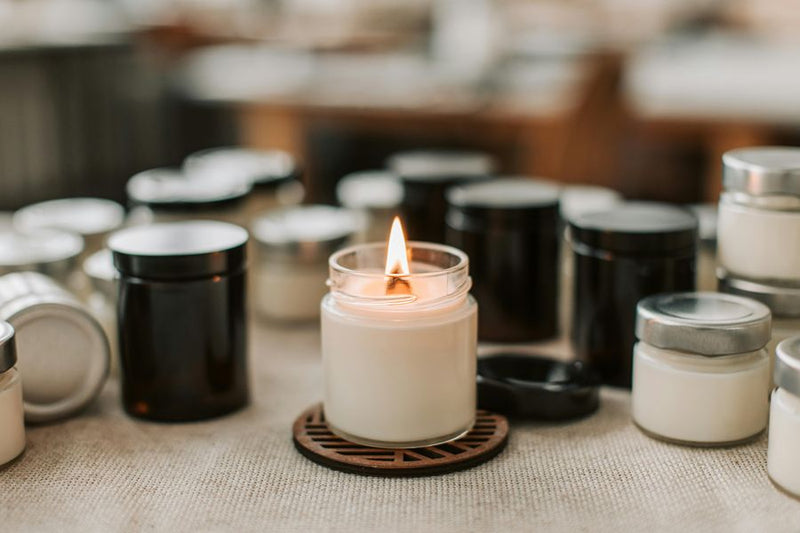
The pool of liquid wax around the flame is the clearest signal you have. A full melt pool reaching the vessel wall means the wick is right. Anything less and you are burning a well down the middle.

Too small, too large
An undersized wick tunnels and leaves a ring of wasted wax. An oversized wick mushrooms, soots, and gets hot enough to crack glass. Wick diameter scales with vessel diameter — not with how the candle looks.

The first burn rule
Wax has memory. On the first burn, let the melt pool reach the edge before you put it out — usually two to three hours. Whatever diameter it reaches is the diameter it returns to for the rest of its life.

Cold throw vs hot throw
Cold throw is what you smell from an unlit candle. Hot throw is what fills the room once it burns. They are not the same, and a candle that smells overwhelming cold can fall flat when lit.

Fragrance load
The percentage of fragrance oil by wax weight — usually 6 to 10%. Push past what the wax can physically hold and the oil separates out. More fragrance does not mean more scent; it means a worse candle.

Blending without competing
Citrus, floral, woody, gourmand, fresh. We walk you through combining two or three so they layer instead of cancelling out — and we build in a reset, because your nose fatigues faster than you expect.

Tunnelling & sinkholes
Tunnelling is an undersized wick or a first burn cut short. Sinkholes are air trapped as the wax contracts while cooling, and are fixed with a second top-up pour rather than thrown away.

Frosting & wet spots
Frosting is the white crystalline bloom on soy — natural, cosmetic, harmless. Wet spots are wax pulling away from the glass as it cools. Neither means your candle is broken, and we explain why.

Sooting & smoking
Almost always a wick left too long or a fragrance load pushed too high. Trim to a quarter inch before every burn. This single habit does more for a candle than anything else you can do at home.