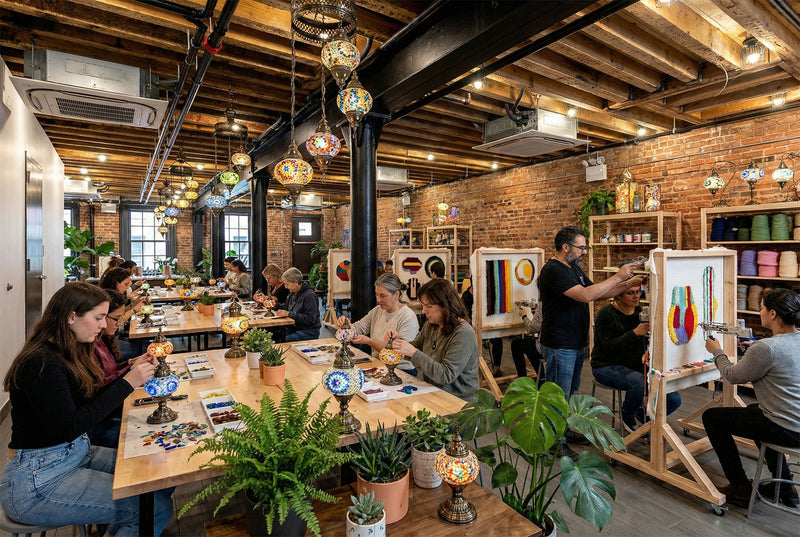
Virtual vs In-Person Team Building: An Honest Comparison
We run both — seven US studios and virtual worldwide. Where each format genuinely wins, the real landed cost once travel is counted, and how to choose.
KSWritten by the KraftStories studio teamUpdated 2026年8月19日 · 7 min read · 11 factors compared
The short answer
Virtual wins on:Reach, cost per head, lead time
In-person wins on:Depth, spontaneous conversation
Virtual per person:$59–$129
Virtual max group:300
Virtual lead time:7 days with kits
Hybrid single event:Usually a trap
In-person team building produces deeper connection. Virtual team building reaches everyone. That is the whole comparison, and everything below is detail.
If your team sits in one city and you have a travel budget, book in-person — nothing online reproduces the corridor conversation on the way back from the studio. If your team is spread across more than two locations, or anyone would need a flight, virtual wins on every axis that matters, including the one people forget: the colleague in Lisbon is actually there.
We run both formats at scale — seven US studios and live virtual workshops worldwide. Most companies writing this comparison sell only one of the two, which is why most versions of this article reach a conclusion that happens to match the author’s inventory.
The comparison
Side by side
Virtual
In-person
Cost per person
$59–$129; $115 for corporate Ship & Make bundles
Comparable workshop fee, before anything else
Landed cost, distributed team
Workshop fee plus kit shipping
Workshop fee + flights + hotel + ground transport + a lost working day per traveller
Lead time
7 days for US kits; 3–5 days screen-only
Venue and travel booking, typically weeks
Maximum group
Up to 300
Room capacity
Geographic reach
Anywhere a kit can ship, or anywhere at all screen-only
People who can reach the venue
Includes remote staff
By default
Only if you fly them in
Organiser workload
Address collection, headcount
Venue, catering, travel, dietary requirements, accessibility, transport
Depth of connection
Good
Better
Spontaneous conversation
Limited — one channel, one speaker
The main event
Takeaway object
Yes, kit-based formats
Yes
Fails when
Half the team keeps cameras off
Half the team can’t travel
Where in-person genuinely wins
Say this plainly, because vendors who only sell virtual won’t.
Unstructured conversation. A video call has one audio channel. One person speaks and forty listen. A room has fifteen simultaneous conversations, and the valuable ones are the ones nobody scheduled — two people who never work together discovering they should. Breakout rooms approximate this. They do not replicate it.
Reading a room. Facilitators adjust in person in ways they cannot on a grid of thumbnails. Someone disengaging is visible across a room and invisible on a video call.
Occasions that need weight. A five-year anniversary, a team that just shipped something enormous, a merger of two groups who have never met. These deserve the friction of everyone travelling. The effort is the message.
Teams that already sit together. If everyone is in one office, a virtual event held from adjacent desks is faintly absurd.
Where virtual genuinely wins
Reach. This is the big one and it is not close. Every remote employee, every parent who can’t do an overnight, every colleague on another continent participates on identical terms. In-person events routinely exclude a large share of a distributed team, and it tends to be the same people every time. That pattern does real damage over a year.
Landed cost. An $89 workshop is $89 virtual. The same workshop in-person, for a team spread across four cities, is $89 plus flights plus a hotel night plus ground transport plus a working day — per traveller. The workshop fee stops being the number that matters. We break the virtual side down in what virtual team building actually costs per person.
Lead time. Seven days for a kit event. Three to five for screen-only. In-person needs venue availability and travel booking, which for anything above a small group means weeks.
Organiser workload. Virtual requires address collection and a headcount. In-person requires venue, catering, dietary requirements, accessibility, parking, and a contingency for the person whose flight is cancelled.
Scale. Three hundred people can do the same craft workshop simultaneously online. Three hundred people in a room is a conference.
Three we run both ways
Same workshop, same instructors, same object at the end. The only difference is whether the materials arrive in a room or at forty addresses.
This category is thick with confident numbers that trace back to nothing. Two things are worth separating.
Well-supported: structured shared activity beats unstructured social time for building trust between colleagues who don’t work together daily. Giving people something to do — rather than a happy hour with no agenda — is the reliable variable, and it holds in both formats.
Not well-supported: the specific percentages that circulate about virtual team building lifting engagement by exactly 25%, or saving a precise dollar figure per session. We have seen these attributed to studies that don’t exist. We’re not going to repeat them, and we’d treat any vendor quoting them as a signal about the rest of their claims.
What we can tell you is first-party: across 2,500+ Google reviews at 4.9 stars, 1,189 are specific to virtual sessions. People rate the online version highly. That is a fact about our events, not a law of nature.
How to choose
Choose in-person if / choose virtual if
Choose in-person if…
Choose virtual if…
Your team is concentrated in one city, or within comfortable travel of one
Your team spans more than two locations
You have a real travel and venue budget, not a workshop budget
Anyone would need to fly, or would be excluded if they couldn’t
The group fits one room and can still talk to each other
The group is large enough that a single venue becomes the constraint
The occasion is significant — a milestone, a merger, a first meeting
Your budget is per-head rather than per-event
What you need is unstructured time together, and the activity is the excuse
You need it inside three weeks
You want the remote half of your team to stop being the remote half
The hybrid trap
Running one event with some people in a room and others on a screen sounds inclusive and usually isn’t. The room dominates: side conversations, shared jokes, and a camera pointed at a table. Remote participants become an audience.
If you have both, the better patterns are:
Separate but equal — the in-person group does an in-person session, the remote group does the virtual version of the same workshop, both get the same takeaway.
Everyone virtual, from their own desk. Slightly odd for the people in the office, and far fairer. Ask the in-office group to join from their own laptops rather than crowding one conference room camera.
If your team is split across time zones as well as locations, the scheduling problem is a separate one worth solving first.
Not sure which way to go?
Tell us the headcount, where people are based and whether there's a travel budget. We run both formats, so we'll tell you honestly which one fits — including when that's the in-person studio.
For structured activities with something to do, yes — it builds familiarity between colleagues who don’t otherwise interact. It is less effective than in-person for deep relationship-building, and more effective than in-person at including everyone.
Per person, similar for the activity itself. For a distributed team, dramatically cheaper once travel, accommodation, venue and lost working days are counted.
Up to 300. Larger groups need additional facilitators to run breakout rooms.
Yes, and the sequence that works is in-person for the annual milestone and virtual for the regular cadence in between. What doesn’t work is one hybrid event with a room and a screen.
In-person if it’s logistically possible — first meetings benefit most from a room. If it isn’t possible, a kit-based virtual workshop beats a video call with no structure by a wide margin.
More reliably when their hands are busy. A session where everyone is building the same object holds attention in a way a hosted quiz does not, particularly in the evening slots a global team ends up with.
Browse our workshops and find the perfect experience.
On the workshop page, click "🎁 Buying this as a gift?" and add their details.
Add a personal message, choose a delivery date, and we'll handle the rest.
They receive a beautiful email with your message and a gift code, then pick whichever session date works for them. No account, no checkout — their seat is already paid for.