The most-quoted crafting statistic on the internet — “crafting reduces stress by 70%” — does not exist. Nobody measured it. What does exist is better: a study of 7,182 adults in which crafting predicted a stronger sense that life is worthwhile than being employed did; a lab experiment in which 75% of participants had lower cortisol after 45 minutes of making art; and a body of peer-reviewed, government and industry data that we have traced, one number at a time, to its source.
This is a list of 54 crafting statistics for 2026, covering what research says about creative activities and mental health, who actually makes things, the size of the maker economy, and why group crafting matters for connection. Each statistic links to the original study, survey or report — not to a blog quoting it — and was verified against that page on 31 August 2026. At the end there is a table of the numbers we refused to repeat.
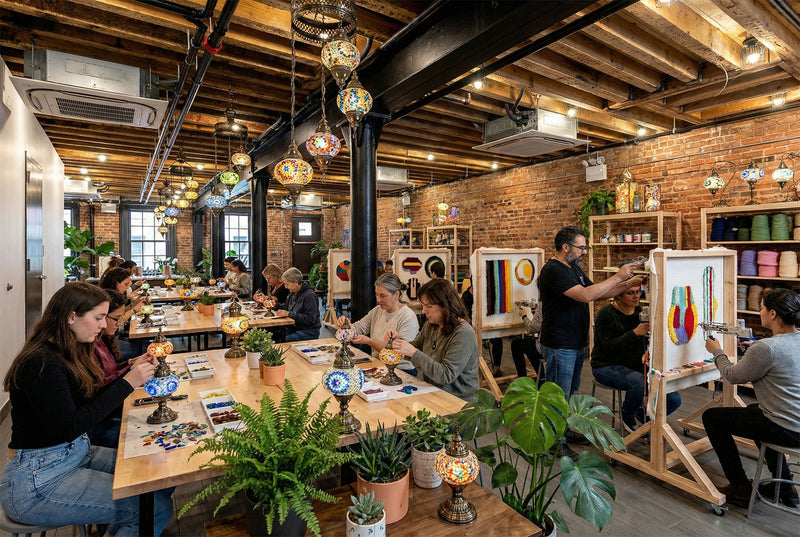
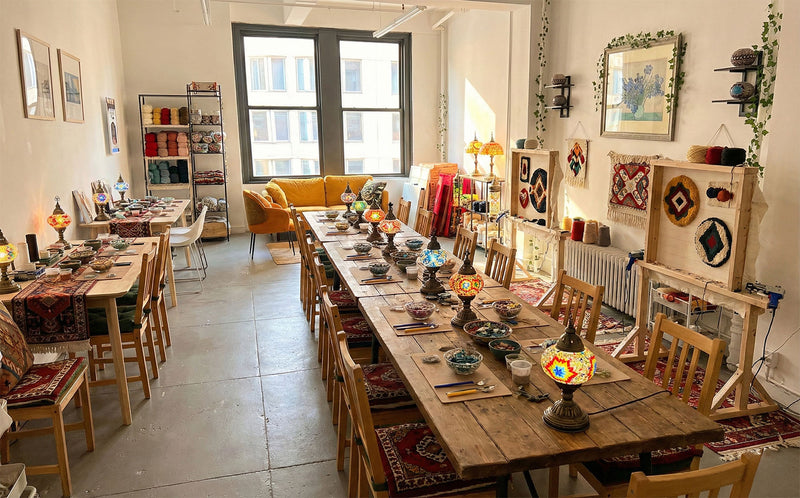
We run craft workshops — mosaic lamps, terrariums, candles, rugs — in seven U.S. studios and online. That gives us an obvious reason to want this data to be flattering, which is why none of it is ours and why we have kept the findings that complicate the story, such as the study that found no crafting effect on loneliness.
Crafting statistics: 10 numbers to know in 2026
- Crafting had a larger effect on feeling life is worthwhile than being in employment among 7,182 adults (Keyes et al., Frontiers in Public Health, 2024).
- 75% of participants had lower cortisol after 45 minutes of art-making, regardless of prior experience (Kaimal, Ray & Muniz, Art Therapy, 2016).
- 81.5% of knitters felt “a little” to “very happy” after knitting, versus 23% who felt sad before starting (Riley, Corkhill & Morris, 2013).
- Having a hobby was linked to fewer depressive symptoms and higher happiness across 93,263 older adults in 16 countries (Mak, Fluharty & Fancourt, Nature Medicine, 2023).
- 52% of U.S. adults did some form of art-making in 2022 (National Endowment for the Arts).
- 1.3 million people were referred to social prescribing by their GP in England in 2023 (UCL / Lancet Public Health, 2025).
- Wellbeing scores rose by up to 18–20 points in a U.S. arts-on-prescription program, twice the threshold for a meaningful change (Art Pharmacy study, Frontiers in Public Health, 2026).
- Etsy's marketplace had 86.5 million active buyers and 5.6 million active sellers at the end of 2025 (Etsy, Inc., February 2026).
- Loneliness affects 1 in 6 people worldwide and is linked to 871,000 deaths a year (WHO Commission on Social Connection, 2025).
- 57% of Americans said an experiential purchase made them happier than a material one; 34% said the reverse (Van Boven & Gilovich, Journal of Personality and Social Psychology, 2003).
Crafting and mental health: what peer-reviewed research shows
Most of what circulates about the benefits of crafting is anecdote dressed as data. The studies below are the ones with samples, methods and journals attached, and their findings are more modest and more convincing than the marketing versions.
Stress, cortisol and calm
- 75% of participants had lower cortisol after 45 minutes of free art-making, and prior art experience made no difference to the result. Kaimal, Ray & Muniz, Art Therapy 33(2), 2016 (Drexel University)
- People who did more enjoyable leisure activities had lower blood pressure, lower cortisol, smaller waist circumference and lower BMI, plus lower depression and negative affect, across 1,399 adults. Pressman et al., Psychosomatic Medicine, 2009
- All 19 studies in the first systematic review of crafts-based interventions reported short-term improvements in outcomes including anxiety, stress, depression, self-esteem and life satisfaction — with the authors noting that more high-quality trials are needed. Bukhave et al., Australian Occupational Therapy Journal, 2025
Mood, depression and wellbeing
- Crafting had a larger effect on people's sense that life is worthwhile (β = 0.218) than being in employment (β = 0.136), in an analysis of 7,182 adults in England. Keyes et al., Frontiers in Public Health, 2024
- Crafting predicted a lift in happiness similar to being roughly 20 years older (β = 0.128 vs 0.127) and a bigger rise in life satisfaction than living in a less deprived area — but no significant effect on loneliness, a finding worth remembering before anyone claims otherwise. Keyes et al., 2024
- People felt more positive and more “flourishing” the day after doing more creative activity than usual, in a 13-day diary study of 658 young adults; the reverse direction (good mood causing creativity) was not supported. Conner, DeYoung & Silvia, Journal of Positive Psychology, 2018
- After knitting, 81.5% of 3,514 knitters (from 3,545 responses) rated themselves “a little” to “very happy” and under 1% still felt sad, compared with 23% who were sad before they started. Riley, Corkhill & Morris, British Journal of Occupational Therapy, 2013
- Six weekly clay art therapy sessions produced significantly greater improvement in depressive symptoms than a non-directive visual-art control in a randomized trial of 106 outpatients with major depression, maintained at follow-up. Nan & Ho, Journal of Affective Disorders, 2017
Hobbies, arts and long-term health
- Among 93,263 people aged 65 and over in 16 countries, having a hobby was associated with fewer depressive symptoms, higher happiness and higher life satisfaction; hobby prevalence ranged from 51% in Spain to 96% in Denmark. Mak, Fluharty & Fancourt, Nature Medicine, 2023
- Adults aged 50 and over who engaged with the arts every few months or more had a 31% lower risk of dying over 14 years; once or twice a year, 14% lower. This measured receptive engagement — museums, concerts, theater — rather than making. Fancourt & Steptoe, BMJ, 2019
- Older adults attending cultural venues every few months had a 32% lower risk of developing depression over 10 years; monthly or more, 48% lower — again receptive engagement (museums, theater, cinema), not making. Fancourt & Tymoszuk, British Journal of Psychiatry, 2019
- The World Health Organization's scoping review drew on more than 3,000 studies and found “a major role for the arts” in preventing ill health and managing illness across the lifespan. Fancourt & Finn, WHO Regional Office for Europe, 2019
If you want to try any of this without a studio, our guide to craft kits for adults is sorted by what each one does for stress and attention.
Arts on prescription: crafting as healthcare
“Social prescribing” — a doctor referring a patient to a creative or community activity instead of, or alongside, medication — has moved from pilot to policy in the UK and is spreading in the U.S. The numbers are large.
- One arts-on-prescription scheme (Artlift, Gloucestershire) reported 37% less demand for GP appointments and 27% fewer hospital admissions after six months, a net saving of £216 per patient, according to the APPG's Creative Health report; the underlying evaluation is unpublished. All-Party Parliamentary Group on Arts, Health and Wellbeing, Creative Health, 2017
- A social return of £4 to £11 for every £1 invested has been calculated for arts on prescription. APPG Creative Health, 2017
- 1.3 million people were referred to social prescribing by their GP in England in 2023 alone, supported by more than 3,300 link workers. UCL / Lancet Public Health, 2025
- 9.4 million GP consultations involved social prescribing between 2019 and 2023, and the share of patients from the most deprived areas rose from 23% to 42%. UCL, 2025
- Local evaluations report GP-appointment reductions ranging from 6% to 50% depending on the site — 42.2% in Tameside & Glossop against 5.6% in a control group — and a return of £2.14 to £8.56 per £1 invested. National Academy for Social Prescribing, 2024
- In the U.S. Art Pharmacy program, WHO-5 wellbeing scores rose at every follow-up, peaking at 18–20 points (Cohen's d 1.03–1.15) among participants assessed after their sixth to eighth arts activity — twice the 10-point threshold the authors cite for a meaningful change — in a 239-person sample in California and Georgia. Frontiers in Public Health, 2026
- Massachusetts' CultureRx pilot generated 414 referrals through 20 healthcare providers and 12 cultural organizations; 92% of Museum of Fine Arts participants said they would do it again. Frontiers in Public Health, vol. 10, published January 2023
Who makes things: crafting participation statistics
- 52% of U.S. adults did some form of art-making in 2022, and 48% attended at least one arts event in person. National Endowment for the Arts, Survey of Public Participation in the Arts 2022
- 11.7% of U.S. adults did weaving, crocheting, quilting, needlework, knitting or sewing in 2022 (down from 13.8% in 2017), and 8.9% did leather, wood or metal work — up from 6.6%. NEA, Arts Participation in 2022: A Technical Summary Report, August 2025
- 16.3% of U.S. adults created, practiced or performed art in the previous month in mid-2024, and 25% attended a live performance or exhibit. NEA, 2024
- 37.4% of adults in England had done at least one craft activity in the past year. Keyes et al., 2024 (Taking Part Survey)
- 91% of adults in England engaged with the arts in 2024/25, falling to 84% in 2025/26 (83% physically, 36% digitally). DCMS, Community and Engagement Survey 2025/26
- Americans spent 2.6 hours a day watching TV in 2025 — half of all leisure time; men averaged 5.6 and women 4.8 hours of leisure a day. U.S. Bureau of Labor Statistics, American Time Use Survey 2025 (released June 2026)
- The share of Americans who socialized in person on an average day fell from 38% in 2015 to 30% in 2025, while time on games and computer use rose from 25 to 37 minutes. BLS, American Time Use Survey 2025 (released June 2026)
The maker economy: handmade crafts, small businesses and younger consumers
The craft market is large, fragmented and badly measured, which is why market-size headlines disagree by 20% or more. We cite company filings and industry bodies first, and label the one market-research estimate as an estimate.
- Etsy's consolidated gross merchandise sales were $11.9 billion in 2025 (down 5.3%), on revenue of $2.88 billion (up 2.7%). Etsy, Inc., Q4/FY2025 results, February 2026
- Etsy ended 2025 with 93.5 million active buyers and 8.8 million active sellers across its marketplaces; the Etsy marketplace alone had 86.5 million buyers, 5.6 million sellers and 5.9 million “habitual buyers.” Etsy, Inc., 2026
- The U.S. creative products industry was valued at $43 billion, with 63% of households taking part in at least one creative activity — the most recent industry-body sizing, now dated. Association For Creative Industries, 2017
- The biggest U.S. creative categories by household participation were painting and drawing (41.0 million households), edible arts (39.7 million), kids' crafts (37.0 million), paper crafts (36.5 million) and sewing and fabric (32.2 million). AFCI, 2017
- The global arts and crafts market is forecast to grow by $42.9 billion between 2026 and 2030 at a 9.4% CAGR, with North America contributing 31.9% of growth — a market-research estimate, not a measurement. Technavio
- 73% of UK adults bought craft in 2019, purchasing almost 25 million handmade objects, and 32% of craft buyers are under 35. Crafts Council, The Market for Craft, 2020
- 10.3 million Britons buy craft online — more than triple a decade earlier — and 85% of Americans surveyed said they would buy a piece of craft. Crafts Council, 2020
- 74% of the 18–35-year-olds surveyed by Eventbrite think in-person experiences are more important than digital ones, and flower-arranging events on the platform jumped 282% in the UK. Eventbrite, Social Study, January 2026
For context on the retail side: JOANN, the major U.S. fabric and craft chain, closed all of its nearly 800 stores in 49 states by the end of May 2025 after its second bankruptcy (NPR, February 2025) — a reminder that demand for crafts and demand for craft-supply big boxes are not the same thing. Our own supplies and kits ship from the studios.
The mental health context
The reason crafting statistics get attention is the size of the problem they are set against. These are the current figures — the WHO updated its prevalence numbers in late 2025, and the “1 in 8 / 301 million” set still found in most articles is out of date (for depression, the WHO's depression fact sheet now gives 332 million, while its mental-disorders sheet still carries the 2019 figure of 280 million).
- Nearly 1 in 7 people worldwide (1.1 billion) were living with a mental disorder in 2021. World Health Organization, 2025
- 359 million people were living with an anxiety disorder and about 332 million with depression — an estimated 5.7% of adults globally. WHO, 2025 / WHO, 2025
- 23.4% of U.S. adults had any mental illness in 2024, 5.6% had serious mental illness and 8.2% had a major depressive episode; among adolescents the rate of a major depressive episode fell to 15.4% from 20.8% in 2021. SAMHSA, 2024 National Survey on Drug Use and Health
- 54% of U.S. adults said they felt isolated, 50% left out and 50% lacking companionship often or some of the time; 69% needed more emotional support than they received, up from 65%. American Psychological Association, Stress in America 2025
- 92% of U.S. adults say relationships are a key source of meaning, even as 75% report being more stressed about the country's future than they used to be. APA, 2025
- 1 in 6 people worldwide is affected by loneliness, which is linked to an estimated 871,000 deaths a year — about 100 every hour; 17–21% of 13–29-year-olds report feeling lonely. WHO Commission on Social Connection, 2025
- Time Americans spend in person with friends fell from 60 minutes a day in 2003 to 20 minutes in 2020; for 15–24-year-olds it dropped nearly 70%. U.S. Surgeon General, 2023
- U.S. teens spend an average of 4.8 hours a day on social media, and four in ten say they are online “almost constantly.” Gallup, 2023 / Pew Research Center, 2025
We write about the screen-time side of this for parents in creative screen time for kids.
Creativity and confidence statistics
Half the people who walk into our studios say some version of “I'm not creative.” The data suggests they are in the majority, and that the belief is learned.
- Only 1 in 4 people believe they are living up to their creative potential, and 75% feel growing pressure to be productive rather than creative at work. Adobe, State of Create, 2012
- More than half of people feel creativity is being stifled by the education system — 70% in the U.S. — and only 39% globally (about half in the U.S.) describe themselves as creative. Adobe, 2012
- Only 31% of people feel they are reaching their creative potential, while 78% say businesses that invest in creativity see higher employee productivity. Adobe, State of Create, 2016
- Creative thinking ranks fourth among the core skills employers consider essential in 2025 (it ranked second in the 2023 edition), and employers expect 39% of workers' core skills to change by 2030. World Economic Forum, Future of Jobs Report 2025
- Low-income students with high arts involvement had a 4% dropout rate versus 22% for those with low involvement, and 71% versus 48% went on to college. Catterall et al., National Endowment for the Arts, 2012
Group crafting, connection and the workplace
The stress findings above mostly come from people making things alone. The connection findings come from people making things together, which is the version we sell, so read the next set knowing that.
- Just over half of knitters (50.3%) knit in a group, and 86% of those group knitters said knitting with others gave them a feeling of belonging; among knitters with depression, being in a group was significantly associated with feeling happier. Riley, Corkhill & Morris, 2013
- Older adults in weekly professionally run arts programs reported fewer falls, fewer doctor visits and better depression scores than controls in site-level results from a 300-person study across Washington DC, Brooklyn and San Francisco. Cohen et al., NEA Creativity and Aging Study, 2006
- U.S. adults who attended live arts events were about half as likely to “always” feel lonely (2.7% vs 5.1%) and more likely to always receive social and emotional support (29.8% vs 23.4%). NEA, 2024
- Among 12,055 U.S. older adults, participating in community arts groups was associated with higher positive affect, life satisfaction, purpose in life and mastery after matching on background factors. Bone et al., Aging & Mental Health 27(6), 2023 (online 2022)
- Employees' creative activity outside work was positively associated with job creativity and helping behaviors — including when rated by co-workers and subordinates — and with recovery experiences of mastery, control and relaxation. Eschleman et al., Journal of Occupational and Organizational Psychology, 2014
- 57% of Americans said an experiential purchase made them happier than a material one; only 34% said the reverse (n = 1,279). Van Boven & Gilovich, Journal of Personality and Social Psychology, 2003
- 78% of millennials would choose to spend money on a desirable experience over buying something desirable, and 72% want to increase their spending on experiences — the original survey behind a statistic usually quoted without a source. Eventbrite / Harris Poll, 2014
The workplace version of this evidence — engagement, loneliness at work, what employees say they would trade for connection — is in our team building statistics, and if you are choosing a first workshop, here is what to expect.
Crafting statistics we refused to include
We traced each of these and either found no source, or found that the source says something different.
| Claim | Where it circulates | Why we left it out |
|---|---|---|
| “Crafting reduces stress by 70%” (or 68%, 73%) | Craft-supply blogs, seller blogs, stat roundups | No study reports it. The closest real finding is Kaimal 2016: 75% of 39 participants had lower cortisol — a different claim. |
| “81% of people with depression felt happy after knitting; 54% felt very happy” | Repeated from a 2013 press cycle | Misquote. The paper says 81.5% of all respondents felt a little to very happy; no 54% figure appears in it. |
| “Knitting lowers heart rate by 11 beats per minute” | Knitting and wellness sites | Anecdotal; no published measurement. Riley 2013 collected self-reported mood, not heart rate. |
| “Art therapy is 80% effective” | Wellness marketing | No source; meta-analyses report effect sizes, not a success rate. |
| “People retain 75% of what they do” (the learning pyramid) | Workshop marketing | No empirical origin; debunked in the education literature. |
| “Creative people live 10 years longer” | Social media | Untraceable. The mortality evidence (Fancourt & Steptoe 2019) is a 31% lower risk for receptive arts engagement, not years of life. |
| “1 in 8 people have a mental disorder; 301 million anxiety; 280 million depression” | Nearly every 2022–25 stat post | Outdated for overall prevalence and anxiety (now 1 in 7 and 359 million); for depression, the WHO's depression fact sheet gives 332 million while its mental-disorders sheet still shows 280 million (2019). |
| “Creative thinking is the 2nd most important skill (WEF)” | Creativity blogs in 2024–26 | True of the 2023 report; the 2025 edition ranks it fourth. |
| “The global arts and crafts market is worth $50 / $56 / $62 billion” | Aggregators quoting different research firms | Figures vary by 20%+ between vendors and definitions. |
| “Etsy has 96 million active buyers” | Older stat posts | Outdated; Etsy's FY2025 release gives 93.5 million consolidated, 86.5 million on the Etsy marketplace. |
| “Crafting cuts dementia risk by 30–50% (Mayo Clinic)” | Craft blogs | The Mayo study linked crafts to lower odds of mild cognitive impairment in a cross-sectional sample; the 30–50% framing and “dementia” wording are not what it reports. |
How we verified these crafting statistics
Every figure was checked against the journal abstract, university release, government page, industry-body report or company filing that produced it, on 31 August 2026. Where a publisher blocked access, we verified through the registered abstract or an institutional copy of the same paper. We excluded aggregator sites entirely, labeled the single market-research forecast as an estimate, dated the older industry study rather than pretending it is current, and where an original evaluation is unpublished (one UK arts-on-prescription scheme) we say so. The WHO–Lancet Global Series on arts and health is due in September 2026; we will update this page when it lands.
To cite this page: KraftStories (2026). Crafting Statistics 2026: 54 Verified Numbers on Mental Health, Creativity and the Maker Economy. https://kraftstories.com/blogs/diy-and-crafts/crafting-statistics. Please link to the primary source alongside us.
Frequently asked questions
Is there scientific evidence that crafting is good for mental health?
Yes, with limits. Kaimal 2016 found lower cortisol in 75% of participants after 45 minutes of art-making; Keyes 2024 found crafting predicted higher wellbeing among 7,182 adults; Conner 2018 found next-day gains in mood after creative activity. A 2025 systematic review found short-term improvements in all 19 studies but called for stronger trials.
Does crafting reduce loneliness?
Crafting alone, not measurably — the Keyes 2024 study found no significant effect on loneliness. Crafting with others is different: 86% of group knitters reported a feeling of belonging, and live-arts attendees were about half as likely to always feel lonely.
What percentage of adults do crafts?
In the U.S., 52% of adults did some form of art-making in 2022 and 11.7% did fiber crafts such as knitting, crocheting or sewing. In England, 37.4% of adults had done a craft activity in the past year.
How big is the craft market?
Nobody measures it precisely. Etsy alone processed $11.9 billion in gross merchandise sales in 2025 with 86.5 million active buyers; the U.S. creative products industry was last sized by its trade body at $43 billion; and one market-research forecast projects $42.9 billion of global growth from 2026 to 2030.
What is arts on prescription?
A doctor or link worker referring a patient to arts or crafts activities as part of care. England's GPs referred 1.3 million people to social prescribing in 2023, and a U.S. program recorded a peak 18–20-point rise in WHO-5 wellbeing scores among participants assessed after six to eight arts activities.
Do you need to be creative to get the benefits of crafting?
No. In the cortisol study, prior art experience had no relationship to the result. Only 39% of people globally describe themselves as creative, and most of the outcomes above were measured in ordinary adults, not artists.
KraftStories runs in-person craft workshops in Midtown NYC, NYC Financial District, Honolulu, San Francisco, San Jose, Irvine and Austin, and live virtual workshops worldwide with kits shipped to participants. 4.9 stars across 2,500+ Google reviews. Find a studio or browse virtual classes and kits.