Quick answer: the best team building activities in NYC in 2026 fall into five groups — hands-on creative workshops ($79–$150 per person), competitive games like escape rooms and axe throwing ($35–$70), food and drink experiences ($75–$175), outdoor and city-based events ($40–$120), and virtual or hybrid formats ($40–$115 per kit). Below are 45 specific options across Manhattan and Brooklyn, sorted by type, with what each costs, the group size it suits, and how far ahead to book. Most Manhattan teams we host are 8–20 people, spend about $1,100 on the activity, and book roughly two weeks out.
This guide is written by KraftStories, a craft studio with two Manhattan locations that hosts corporate groups every week. We've listed our own workshops in the creative section, and we've listed our competitors too — a guide that only recommends its author isn't a guide. Prices are typical 2026 ranges for the activity only; food, drink and private-room fees are called out separately where they apply.
How to use this list
- Under 12 people: almost everything works. Pick by personality: quiet teams do better with creative or food formats; loud teams love competitive ones.
- 12–30 people: you need a venue that can run parallel groups (multiple escape rooms, multiple lanes, a studio with two tables) or a single large-format activity (scavenger hunt, cooking competition, workshop with 30+ seats).
- 30–100+ people: scavenger hunts, game shows, boat charters, private venue buyouts, or a workshop vendor that comes to your office. Book 4–6 weeks ahead.
- Q4 (October–December): everything is 2–3× harder to book. Thursdays and Fridays fill first. Book in September for December.
Creative and hands-on workshops
Best for mixed teams, cross-department groups, and anyone who's tired of competition-based events. Everyone leaves with something they made, which is the reason these photograph well and get talked about the following week.
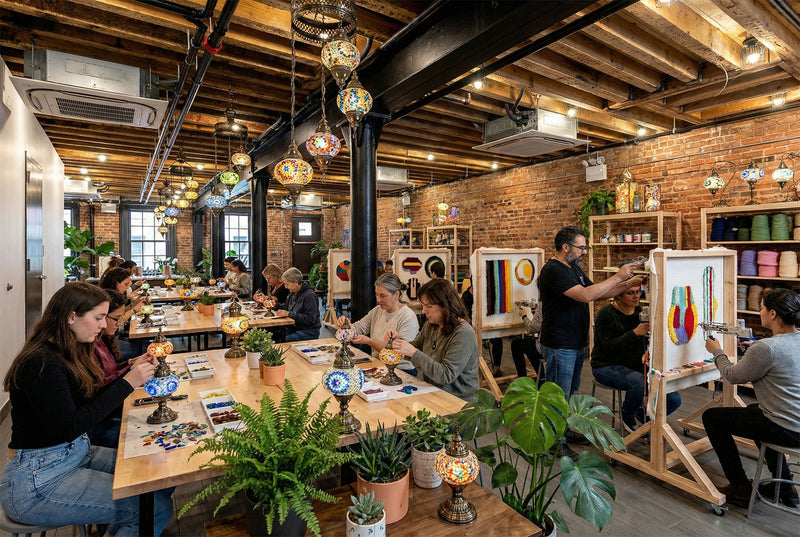
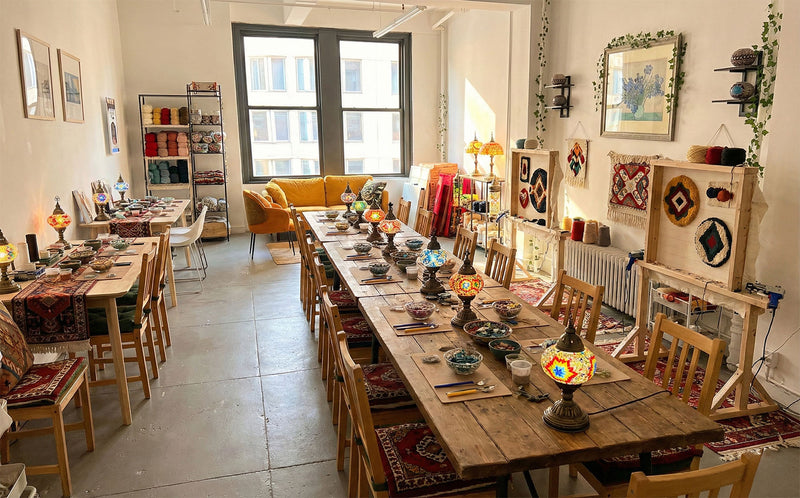
1. Turkish mosaic lamp workshop — KraftStories (FiDi & Midtown)
Each person designs and builds a stained-glass mosaic lamp from thousands of glass pieces, then takes it home. 2 hours, no experience needed, all materials included. $99–$149 per person, groups of 8–40 per studio, private studio hire included for groups of 10+. BYO food and drink welcome. Also available as a mobile workshop at your office and as a virtual Ship & Make kit. Details and booking.
2. Rug tufting workshop — KraftStories
Teams use tufting guns to make a small rug or wall piece from their own design. Loud, physical, oddly addictive. 2–2.5 hours, $129–$149 per person, groups of 6–20. Good for design and product teams who want a "we made a thing" energy.
3. Terrarium or moss art workshop — KraftStories
The calmer option: build a self-sustaining terrarium or a preserved-moss wall piece. 90 minutes, $79–$99 per person, groups up to 40. This is what we recommend for wellness-themed offsites and for teams with mixed physical abilities.
4. Pottery wheel class
Studios across Manhattan and Brooklyn run private group wheel sessions. Expect $85–$130 per person, 2 hours, and a cap of 8–12 per session because wheels are limited — larger groups split into shifts or do hand-building instead. Pieces are fired and collected 2–3 weeks later, so nobody leaves with a finished object on the day.
5. Candle making
Pour-your-own soy candle sessions at studios in SoHo, Chelsea and Williamsburg. $55–$95 per person, 60–90 minutes, groups of 10–30. Quick and easy; pairs well with a happy hour afterwards.
6. Flower arranging or bouquet bar
Florists in Chelsea Flower District and Brooklyn host private arranging classes. $85–$150 per person, 90 minutes, groups up to 30. Very popular for spring and Mother's Day-adjacent dates.
7. Paint and sip
The default "creative" corporate event for a reason: cheap, scalable, drinks included. $45–$75 per person, 2 hours, groups of 10–60. Downside: it's the format most teams have already done.
8. Graffiti and street-art workshop
Studios in Bushwick and the Lower East Side run private graffiti sessions where the team paints a shared canvas or wall. $75–$125 per person, 2 hours, groups of 10–40. Strong for brand or culture-themed offsites where you want a collaborative artifact.
9. Glassblowing
Brooklyn glass studios offer group sessions where each person makes a paperweight or ornament with an instructor's help. $110–$175 per person, small groups (6–12) because of furnace time. Book 3–4 weeks ahead.
10. Woodworking or leather-craft class
Makerspaces in Brooklyn and Long Island City host private build sessions (cutting boards, wallets, small furniture). $95–$160 per person, 2–3 hours, groups of 8–16.
11. Improv workshop
Theatres like the Magnet and PIT offer corporate improv sessions focused on listening and communication rather than being funny. $60–$100 per person or a flat $1,200–$2,500 per group, 2 hours, groups up to 30. One of the highest-rated formats for manager and sales teams.
12. Perfume or cocktail-bitters blending
Newer niche formats where each person blends their own scent or bitters. $90–$140 per person, 90 minutes, groups of 8–25.
Competitive and game-based activities
Best for sales teams, young teams, and groups that already know each other. The main risk is that competitive formats amplify existing dynamics — the loud people get louder.
13. Escape rooms
Manhattan has dozens of operators (Mission Escape Games, Escape the Room, The Escape Game, Beat the Bomb's puzzle rooms, Clue Chase). $35–$55 per person for a public room, $300–$450 per private room of 6–10. Groups of 20+ book several rooms in parallel. 60 minutes plus briefing.
14. Beat the Bomb
Teams work through laser mazes and puzzle rooms and, if they fail, get hit with a paint bomb. Ships a very specific energy. $45–$65 per person, groups of 4–8 per team, up to 50+ across teams. Brooklyn (Dumbo) and Manhattan locations.
15. Axe throwing
Kick Axe (Gowanus), Bury the Hatchet and others. $35–$50 per person per hour, groups of 6–60 across lanes. Pair with pizza for an easy two-hour event.
16. Bowling
Bowlero (Chelsea Piers, Times Square) and Brooklyn Bowl. $40–$70 per person including shoes, 2 hours, scales to 100+. Food and drink packages push this to $90–$120.
17. Ping-pong and shuffleboard
SPiN (Flatiron) and Royal Palms Shuffleboard Club (Gowanus). $30–$60 per person for table/court time, groups of 10–80. Great value for large groups.
18. Mini golf
Swingers (NoMad) and Putting Club-style venues. $35–$55 per person, plus $40–$60 in food and drink packages. Groups of 8–100.
19. Scavenger hunt
Watson Adventures, Museum Hack and others run hunts through the Met, Central Park or downtown. $45–$75 per person, 2–3 hours, groups of 10–500. The most scalable format on this list.
20. Game show and trivia events
Private trivia nights, "Feud"-style game shows, and bingo hosts come to your office or a bar. $30–$50 per person or $800–$2,000 flat, 90 minutes, groups of 10–150.
21. Virtual reality arena
Free-roam VR venues in Midtown and Brooklyn. $45–$65 per person for 45–60 minutes, groups of 4–8 per session, up to 40 in rotation.
22. Karaoke private rooms
Koreatown private rooms. $25–$45 per person per hour plus drinks, groups of 6–30. The lowest-effort, highest-laughter option for teams that already like each other.
23. Go-karts or bumper cars
Indoor tracks in Brooklyn and Queens. $40–$70 per person, groups of 10–60. Needs transport from Manhattan.
Food and drink experiences
Best for client-facing teams, leadership offsites, and end-of-quarter celebrations. These are usually the highest-satisfaction events but also the ones that quietly blow the budget, because food and drink are built in.
24. Cooking competition (Chopped-style)
Kitchens in Chelsea, Midtown and Brooklyn host timed cooking challenges with judging. $110–$175 per person including the meal, 2.5–3 hours, groups of 10–60.
25. Pasta or pizza-making class
Pizza School NYC, Eataly and independent kitchens. $85–$135 per person, 2 hours, groups of 10–40. Kids-at-heart favourite; very photogenic.
26. Cocktail masterclass
Private bars and distilleries (Great Jones Distillery, Brooklyn's Kings County) run hands-on mixing sessions. $75–$125 per person, 90 minutes, groups of 10–40. Include a non-alcoholic track — about one in five people won't drink.
27. Wine or sake tasting
Sommelier-led tastings at wine bars or in your office. $65–$110 per person, 90 minutes, groups of 8–50.
28. Chocolate or macaron making
Chocolatiers in SoHo and Brooklyn. $80–$120 per person, 90 minutes, groups of 10–30.
29. Food tour
Guided walking tours of Chinatown, Lower East Side, Greenwich Village or Williamsburg with 5–7 tastings. $85–$135 per person, 3 hours, groups of 10–40 (split into pods of 12).
30. Brewery or distillery tour
Brooklyn Brewery, Other Half, Kings County Distillery. $30–$60 per person for the tour and tasting, add $40–$60 for food. Groups of 10–50.
31. Private dinner with a chef
A private room or supper club with a set menu. $150–$300 per person. Small leadership groups of 8–20.
Outdoor and city-based activities
Seasonal — May to October in practice. Have a rain plan; every outdoor vendor has a cancellation clause, but your calendar doesn't.
32. Boat charter or sunset sail
Classic Harbor Line, Manhattan by Sail and private charters. $75–$150 per person for 2 hours, groups of 20–150. Book 6+ weeks ahead for summer Thursdays.
33. Central Park field day
Organisers set up relay races, tug-of-war and lawn games. $40–$80 per person, 3 hours, groups of 20–300. Permits needed for 20+; the organiser handles it.
34. Kayaking or paddleboarding
Manhattan Kayak Company and Brooklyn Bridge Park Boathouse. $50–$100 per person, 90 minutes, groups of 6–30.
35. Rooftop yoga or fitness class
Private instructor at a rooftop venue or your office roof. $35–$60 per person, 60 minutes, groups of 10–50.
36. Bike tour
Guided rides over the Brooklyn Bridge or through Central Park. $55–$90 per person, 2–3 hours, groups of 8–40.
37. Volunteering day
Food bank shifts, park clean-ups or building days with organisations like New York Cares or Habitat. Usually free to $25 per person; some companies pair it with a paid lunch. Groups of 10–100. The best-rated format on employee surveys when it's genuine, and the worst when it isn't.
38. Walking tour or architecture tour
Private guides for neighbourhood history, street art or architecture. $35–$70 per person, 2 hours, groups of 10–30.
39. Sports outing
Group tickets for the Yankees, Mets, Liberty or a Knicks game. $60–$250 per person depending on the seats. Groups of 10–200. Easy but passive; better as a reward than as team building.
Virtual and hybrid formats
Still about 10% of the corporate bookings we see, mostly for distributed teams that meet quarterly. Kits shipped to homes work far better than screen-only games.
40. Ship & Make virtual craft workshop — KraftStories
We ship a mosaic candle-holder, terrarium or moss-art kit to each person and run a live 90-minute session on Zoom. $115 per person including shipping in the US; 15-minute setup; book 7–10 days ahead (2–3 weeks for international or 30+ kits). Virtual team building details.
41. Virtual escape room or murder mystery
Hosted on Zoom by companies like The Escape Game and Confetti. $25–$45 per person, 60–90 minutes, groups of 8–200.
42. Virtual cocktail or cooking class with shipped ingredients
$65–$110 per person including the kit. Groups of 10–100.
43. Online trivia or game show
$15–$30 per person or a flat $500–$1,200, 60 minutes, any size. The cheapest option on the list.
44. Hybrid workshop (in-studio plus remote kits)
The in-office team comes to a studio; remote people get the same kit and join on a screen in the room. $99–$149 per person. Works best when remote participants are fewer than half the group.
45. Mobile workshop at your office
Craft, cocktail and cooking vendors will bring the whole activity to your conference room. $85–$150 per person plus a $200–$500 travel/setup fee. Groups of 10–80. This removes the biggest failure point of NYC events — getting 25 people to travel across town at 4pm.
Price comparison by format (Manhattan, 2026)
| Format | Per person | Time | Ideal group | Includes |
|---|---|---|---|---|
| Online trivia / game show | $15–$30 | 60 min | Any | Host only |
| Karaoke, ping-pong, shuffleboard | $25–$60 | 2 hrs | 10–80 | Space only; food/drink extra |
| Escape room, axe throwing, mini golf, bowling | $35–$70 | 1–2 hrs | 6–60 | Activity; food/drink extra |
| Scavenger hunt, field day, walking tour | $40–$80 | 2–3 hrs | 20–300 | Host, materials, permits |
| Paint & sip, candle making | $45–$95 | 1.5–2 hrs | 10–60 | Materials, often a drink |
| Improv, tastings, brewery tours | $60–$110 | 1.5–2 hrs | 8–50 | Instructor, tasting |
| Craft workshops (lamp, tufting, terrarium, pottery) | $79–$150 | 1.5–2.5 hrs | 8–40 | Materials, instructor, private studio, take-home piece |
| Cooking class, food tour, cocktail class | $75–$175 | 2–3 hrs | 10–60 | Ingredients, the meal or tastings |
| Virtual with shipped kit | $65–$115 | 90 min | 10–100 | Kit, shipping, live host |
| Boat charter, private dinner, venue buyout | $150–$300+ | 2–4 hrs | 20–150 | Venue, catering, staff |
What NYC teams actually book
From our own anonymised data across 2,000+ orders (full study here):
- The median corporate group is 11 people; three-quarters are between 8 and 20.
- The median spend on the activity is about $1,100, or $99 per head.
- Teams book a median of 15 days ahead; consumers book 4 days ahead.
- 95% of corporate orders are placed on weekdays, peaking Wednesday around 2pm — which is to say, an office manager on a Wednesday afternoon is who plans these.
- 83% choose in-studio, 10% virtual, 7% mobile at the office.
- 21% of corporate customers rebook within a year, versus 13% of consumers.
Budget examples
- 10 people, $600: escape room ($450 private room) plus pizza. Or trivia at a bar with a $150 tab.
- 12 people, $1,500: a 2-hour craft workshop ($1,200–$1,500 with materials and the studio) — BYO drinks. This is the single most common booking we see.
- 25 people, $3,500: a cooking competition or a workshop plus catered lunch ($110–$140 per head all-in).
- 50 people, $6,000: a scavenger hunt ($60 pp) plus a bar buyout ($60 pp). Or a mobile workshop at your office with catering.
- 100 people, $15,000: boat charter or venue buyout with catering, or a field day plus dinner. Book two months out.
For worked budgets and the add-ons that change the number, see how much team building costs in NYC.
How to choose: a 5-question checklist
- Who's the quietest person on the team, and will they enjoy this? If not, pick a creative or food format over a competitive one.
- Does everyone drink? If the event is built around alcohol, roughly 20% of the team is on the outside of it.
- Where is everyone at 4pm? Travel time across Manhattan kills attendance. Pick a venue within 20 minutes of the office or bring the activity in.
- Do you want a take-home? Craft, cooking-kit and candle formats give people an object; games give people a story. Both work; know which you're buying.
- Is the quote all-in? Ask every vendor for the per-person price with materials, room fee, gratuity and tax. Many "$65 per person" quotes land at $95.
Booking timeline
- January–April: 1–2 weeks' notice is usually fine. Best availability of the year.
- May–September: 2–3 weeks. Outdoor and boat formats need 4–6 weeks.
- October–December: 4–8 weeks. Thursday and Friday slots in December are often gone by early November.
Team building by neighborhood
Where your office is decides more than you'd think. Here's what clusters where.
- Financial District / Lower Manhattan: craft studios (our FiDi studio on the water side of the district), escape rooms near Fulton Street, harbor boat charters from Pier 11 and Battery Park, walking tours of the seaport and Wall Street. Good for firms that can't lose a whole afternoon to travel.
- Midtown / Times Square: the densest cluster of everything — bowling at Bowlero Times Square, multiple escape-room operators, Koreatown karaoke, our Midtown studio, cooking kitchens in the West 30s, and Bryant Park for outdoor events. Loud and easy to reach from any office.
- Flatiron / Chelsea: SPiN ping-pong, Chelsea Piers (bowling, golf, sports), the Flower District for arranging classes, and several cooking studios. The natural pick for a 5th-Avenue-to-8th-Avenue office.
- SoHo / Lower East Side / East Village: candle and chocolate studios, street-art workshops, food tours, small bars for private trivia. Better for groups under 20.
- Brooklyn (Dumbo, Williamsburg, Gowanus): Beat the Bomb, Kick Axe, Royal Palms Shuffleboard, Brooklyn Bowl, glass and woodworking studios, brewery tours. Worth the trip for a half-day offsite; painful for a 4pm Tuesday.
- Long Island City / Queens: makerspaces, go-karts and indoor sports, cheaper venue buyouts. Consider it when the budget is tight and the team is in Midtown East.
Seasonal picks
- January–February: the cheapest months for everything indoors. Craft workshops and cooking classes have wide-open weekday availability. This is when to run the event you couldn't book in December.
- March–April: flower arranging, terrarium and moss-art workshops, early-season walking tours. Spring "reset" themed offsites.
- May–June: boat charters open up, Central Park field days, rooftop classes. Book by mid-April.
- July–August: outdoor everything, kayaking, Governors Island picnics; many teams are short-staffed so groups skew smaller (a good time for the 8-person format).
- September–October: the busiest planning window of the year for Q4 events. Anything you want in December, decide now.
- November–December: holiday-party alternatives — cocktail classes, mosaic lamp and candle workshops (people take gifts home), cooking competitions, private karaoke. Thursdays are gone by early November; Tuesdays and Wednesdays are your friend.
Common mistakes we see
- Booking the format the planner likes, not the team. The person planning is often the most outgoing person in the office. Poll the team once; it costs nothing.
- Choosing an evening slot. Attendance drops and the people with kids leave early. A 3pm start with an optional drink afterwards gets the whole team.
- Forgetting the all-in number. Room fees, gratuity, tax and a "materials fee" can add 30–40% to a headline price. Get it in writing.
- Too many people for the format. Pottery for 25, escape room for 30, glassblowing for 15 — these all turn into waiting around. Match the group to the venue's real capacity, not its marketing.
- No plan for the remote people. If a third of the team is remote and gets nothing, the event costs more in goodwill than it buys. Ship them a kit or pick a hybrid format.
Frequently asked questions
What is the most popular team building activity in NYC?
Escape rooms by volume, because they're cheap and everywhere. Among teams that have already done an escape room, hands-on workshops (craft, cooking, cocktails) are the most common next choice, and they rate higher on post-event surveys because everyone participates equally.
How much should I budget per person for team building in New York?
$35–$70 for a game-based activity, $79–$150 for a workshop or class with materials, $150+ for anything with a full meal or a private venue. Add $30–$50 per person if you're feeding people.
What works for a team of 30–50 in Manhattan?
Scavenger hunts, cooking competitions, bowling or mini-golf buyouts, a workshop that can run 40+ seats, or a mobile workshop at your office. Escape rooms and pottery cap out too early unless you run several sessions.
What are good team building activities for introverts?
Anything with a personal project and no audience: mosaic lamp, terrarium, pottery, candle making, chocolate making. Avoid improv, game shows and karaoke unless the team asked for them.
Do team building venues in NYC let you bring your own food and drink?
Studios and makerspaces usually do (we do at both of ours). Bars, bowling alleys and restaurants usually don't and will sell you a package instead.
What's the best time of day for a team event?
Weekday afternoons from 2–5pm have the best availability and the highest attendance. Evening events after 6pm see 15–25% no-shows in our experience.
Can we do team building in the office?
Yes — trivia hosts, cocktail and craft workshop vendors, and food-station caterers all come to you. Expect a $200–$500 travel/setup fee on top of the per-person rate.
KraftStories hosts corporate teams at its Financial District and Midtown studios and on-site at offices across Manhattan and Brooklyn. Questions about a specific group size or date: team building in NYC or email hello@kraftstories.com.