Your walk through the park is off. Here is what to do instead.
New York is one of the best cities in the world to be rained on, which is fortunate, because it rains here a great deal more than most visitors expect. The city gets around fifty inches a year across roughly a hundred and twenty wet days, which works out at about one day in three, every month of the year.
This guide covers twelve indoor options across Manhattan and Brooklyn, with a rough sense of how long each fills and whether it suits kids, plus the part most guides leave out: how to actually move around a wet New York without ending up soaked. Hours, prices and closing days change, so check the website for anything you plan to build a day around.
There Is No Rainy Season in New York
This is the single most useful thing to understand before you plan around the weather here. Unlike a tropical destination, New York has no wet season and no dry season. The wettest month is July at about four and a half inches; the driest is February at about three and a quarter. That is a difference of roughly an inch. Whatever month you come, plan as though it might rain.

What does change is the character of the rain. From June to September, New York rain often behaves the way rain does in the tropics: a hard convective thunderstorm in the afternoon or evening, forty minutes, then done. You shelter, you wait, your day resumes.
From October to May it does not do that. Autumn, winter and spring rain here is frontal, which means a broad low-pressure system dragging six to twenty-four hours of steady rain across the city at forty-five to fifty-five degrees, usually with wind. There is nothing to wait out. If you are visiting in that window, you want a full-day indoor plan rather than a list of places to duck into for twenty minutes, which is why this guide leads with the big museums.
Full-Day Anchors
Three places that can absorb an entire washed-out day without you resenting it.
1. The Metropolitan Museum of Art
The obvious answer, and it is the right one. Two million square feet on the edge of Central Park, which means you could visit weekly for a year and not finish it. The Egyptian wing and the Temple of Dendur, and the Arms and Armor galleries, are the two reliable wins if you are bringing children who did not choose to be here.
Three practical notes. It is closed on Wednesdays. It stays open until nine on Fridays and Saturdays, which makes it the best place to be when a storm has eaten your whole day. And the pay-what-you-wish admission is for New York State residents, plus students from New York, New Jersey and Connecticut; everyone else pays full price. Three to four hours minimum, and a full day is easy. Good for kids.
2. American Museum of Natural History
The best-designed museum in the city for bad weather, for a reason that has nothing to do with the collection: the B and C subway station at 81st Street exits directly into the building. You can leave your hotel, go underground, and arrive without being rained on once.
Inside, the Richard Gilder Center has been open since 2023 and is the part to prioritise if you have been before: a live insectarium, a butterfly vivarium, and a three-storey wall of open collections storage. Add the dinosaur halls and the blue whale and you have four to five hours without trying. New York State residents pay what they wish for general admission; visitors from elsewhere pay a set price. Best on this list for kids.
3. MoMA
Midtown, a short walk from the E and M at Fifth Avenue, and the most efficient of the big three if you have half a day rather than a whole one. Two to three hours covers it properly.
Honest caveat for a rainy day: the fifth-floor rooms holding the paintings everyone came for get genuinely crowded, and rain pushes more people inside. If you are bringing a stroller or a child who dislikes crowds, go at opening or go on a Friday evening, when admission is free for New York State residents with an advance reservation.
Half-Day Museums
Better choices when the rain is forecast to break, or when you want one good thing and a long lunch rather than a marathon.
4. The Frick Collection
Reopened in April 2025 in its original Gilded Age mansion on East 70th Street after a five-year renovation, and the second floor — the former family living quarters — is open to the public for the first time in the collection's history. It is a house full of Vermeers and Holbeins rather than a museum, which makes it the most pleasant hour and a half in the city on a wet afternoon.
Closed Tuesdays, pay-what-you-wish on Wednesday afternoons, open late on Fridays. One firm restriction: children under ten are not admitted to the galleries. One and a half to two hours.
5. The Morgan Library and Museum
Murray Hill, a few minutes from Grand Central, and the quietest good room in Manhattan. J. P. Morgan's private library is a three-tiered walnut chamber with a Gutenberg Bible in it, and the Renzo Piano glass-roofed atrium alongside is a genuinely lovely place to sit with a coffee and watch rain hit the roof.
Closed Mondays, free on Friday evenings, and the historic library rooms specifically are free on Tuesday and Sunday afternoons, which is an underused loophole. Around ninety minutes. Not a children's museum.
6. The New York Historical
Across the road from the Natural History museum on Central Park West, which makes the two of them the best pairing in the city when you are trying to minimise blocks spent outdoors. It dropped the "Society" from its name in 2024, so older guides and signage disagree.
The reason to go now is the Tang Wing for American Democracy, which opened in June 2026 and added seventy-one thousand square feet, including the Weitzman Shoe Museum. Note that the American LGBTQ+ Museum housed within the new wing is not scheduled to open until 2027, so do not come for that yet. Closed Mondays, pay-as-you-wish on Friday evenings. Two to three hours.
7. The New Museum
The newest thing on this list. The Bowery contemporary art museum reopened in March 2026 with a seven-storey OMA-designed extension that roughly doubled its gallery space, along with a new restaurant and a much larger top-floor Sky Room. If you have been to New York before and want something that was not here last time, this is it.
Closed Mondays, free under eighteen, pay-what-you-wish on Thursday evenings. One and a half to two hours. Contemporary art, so use your judgement about children.
Free, or Nearly
8. New York Public Library, Schwarzman Building
The lions on Fifth Avenue, and it is free. The Polonsky Exhibition of the Library's Treasures is permanent, free and genuinely first-rate: a Gutenberg Bible, a draft of the Declaration of Independence in Jefferson's hand, and the original stuffed Winnie-the-Pooh toys, which are the reason to bring a child. Add the Rose Main Reading Room and a free guided tour and you have a comfortable ninety minutes for nothing.
It is a short covered walk from Bryant Park and Grand Central. The building is part-way through a mechanical renovation, so expect some noise.
9. Grand Central and the Downtown Indoor Network
Grand Central Terminal is open from a quarter past five in the morning until two the next morning, has eighty-odd shops and restaurants, and is worth an hour on its own. Stand in the Whispering Gallery outside the Oyster Bar, put a child at the opposite corner, and speak into the wall.

Downtown does the same trick on a larger scale. The Oculus, Fulton Center, the World Trade Center subway lines, the PATH trains and Brookfield Place connect into the longest continuous indoor walk in Manhattan. While you are there, Printemps opened in 2025 inside the Art Deco One Wall Street, and its Red Room — a 1931 space with two and a half million red and gold mosaic tiles, sealed from public view for two decades — is free to walk into and one of the more startling interiors in the city.
Something Other Than a Museum
10. A Broadway Matinee
Two and a half to three hours indoors in a seat, which is exactly what an all-day soaker calls for. Matinees run on Wednesdays and Saturdays, with some shows adding Sundays or Thursdays, typically at two in the afternoon.
One rain-specific tip: the TKTS discount booth in Times Square has an outdoor queue under the red steps, which is a poor plan in weather. The Lincoln Center booth in the David Rubenstein Atrium is indoors and sells the same tickets, so check its hours and go there instead. Note that the Brooklyn and South Street Seaport booths have closed permanently.
11. The Haupt Conservatory at the New York Botanical Garden
Worth the trip out to the Bronx for the same reason a Victorian glasshouse is always worth it in bad weather: eleven galleries of palms, rainforest, desert and aquatic plants, warm and humid, with rain on the glass overhead. It is the best antidote in the city to a cold grey February.
Two things to get right. Take Metro-North from Grand Central rather than the subway — it is about twenty minutes and drops you across the street, which matters when it is pouring. And buy the All-Garden Pass, not the grounds-only ticket, because the grounds-only ticket does not include the Conservatory and the rest of the garden is two hundred and fifty acres of outdoors. Closed Mondays. Allow a half day including travel.
Making Something Indoors
12. A Craft Workshop in Midtown or the Financial District
Full disclosure, this one is ours. We run two New York studios: Midtown at 325 W 38th Street in the Garment District, a few minutes from Port Authority and Times Square, and the Financial District at 93 Pearl Street, near Fulton Street and Stone Street.
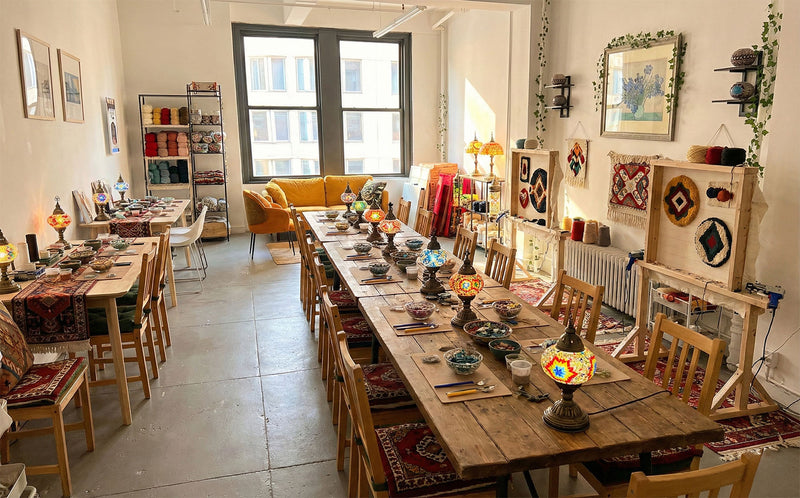
You sit down and make something over a couple of hours: a tufted rug, a Turkish mosaic lamp, a terrarium, a soy candle, moss wall art, lantern making. It is fully indoors, it suits both adults and kids depending on the workshop, and you leave with the thing you made rather than a photo of it. Rainy weekends are our busiest, sessions are booked in advance, and they do fill up, so check availability before heading over. Around two hours.

Getting Around a Wet New York
This is the part that actually determines whether your day is pleasant, and almost no guide covers it.
Pick stations, not lines. The difference between a dry day and a wet one is usually which station you use. The B and C at 81st Street exits inside the Natural History museum. The 2 and 3 at Eastern Parkway stops at the Brooklyn Museum's door. Grand Central, the Oculus and Fulton Center connect large indoor areas underground. Choosing attractions by station adjacency is worth more than any amount of umbrella.
The crossings are the wet part, not the blocks. Manhattan sidewalks are almost continuously covered by awnings, building overhangs and construction sheds, and you can walk a surprising distance nearly dry. What gets you is the intersection: no cover, a forced wait at the light, and the lake that forms at the corner where the storm drain has given up. Waterproof shoes are worth more here than a good umbrella.
Buy the street umbrella, but do not rely on it. Vendors appear at subway exits within minutes of rain starting, and five to ten dollars for a stopgap is a fair trade. They also invert in the first real gust. A hooded rain jacket beats an umbrella on any windy day, and New York rain is frequently windy because the avenues funnel it.
Do not enter the subway during a flash flood warning. The system's drainage is overwhelmed by roughly an inch and a half of rain in an hour, and water comes in through street stairs and sidewalk grates. In July 2025 Central Park recorded more than two inches in a single hour and several lines flooded. During an active warning, stay above ground or stay indoors, check the MTA alerts before you descend, and remember buses keep running when trains do not.
What Not to Plan on a Wet Day
The Intrepid Museum. A great museum in good weather and a poor rainy day choice. The flight deck is outdoors and closes when it is too slippery, the submarine is on the pier, and reaching the Space Shuttle pavilion means crossing open deck. On top of that, no subway is close, so you have a long exposed walk west across the highway in both directions.
The Statue of Liberty and Ellis Island. Mostly ferry and mostly outdoors, and the queues are exposed. Save it.
Rooftop observatories. The Empire State Building, Top of the Rock, Edge and Summit all sell you a view. In low cloud there is no view, and most do not refund you for weather. Check the cloud base before you book, not after.
The High Line. Elevated, exposed and windy. Chelsea Market sits across the street and is the standard substitute, though be warned that everyone else has the same idea and it gets crowded precisely when it rains.
What Guides Still Get Wrong
Two corrections worth having before you set out.
The Rubin Museum has closed. Its Chelsea galleries shut permanently in October 2024 after twenty years, and the organisation now operates without a building. Plenty of rainy-day lists still send people to West 17th Street. The good news is that its signature Tibetan Buddhist Shrine Room has been reinstalled at the Brooklyn Museum and is on view there into 2031, so the thing most people went for is still visitable — and the Brooklyn Museum has a subway station at its front door, which makes it a strong wet-day destination in its own right. It is closed Mondays and Tuesdays.
Fotografiska New York has closed permanently. The Park Avenue South photography museum shut in 2024 and the company has not announced a new New York location.
If You Are Stuck in One Part of the City
Midtown
The best-covered part of the city. MoMA, the Public Library, Grand Central, a Broadway matinee and our Midtown studio are all here, and much of the walking between them is under awnings and scaffolding. You do not need to leave the neighbourhood.
Upper East and Upper West Side
Museum Mile on one side, the Natural History museum and the New York Historical on the other. Pick a side and stay on it rather than crossing the park in the rain, which takes longer and is more exposed than it looks on a map.
Downtown and the Financial District
The Oculus network, Printemps, the 9/11 Memorial Museum and our Pearl Street studio, with the largest continuous indoor walking area in Manhattan connecting most of it. If you are staying downtown, a storm barely needs to change your plans.
Lower East Side and Brooklyn
The New Museum and the Tenement Museum are both here, though the Tenement Museum runs guided tours only, involves a lot of stairs, and excludes under-fives from most apartment tours, so book ahead and read the tour descriptions. Across the river, the Brooklyn Museum is the anchor.
What About the Evening?
Rain matters least after dark, when almost everything you would be doing is indoors anyway. A wet evening is a good one for a show, a long dinner, live music, or a museum that stays open late — the Met on Fridays and Saturdays, MoMA and the Whitney on Fridays, the Morgan on Fridays.
Evening workshops work for the same reason. You are not giving up daylight to sit inside, which makes it an easy thing to add to a day the weather already interrupted.
When Does It Actually Rain in New York?
All year, fairly evenly. Central Park averages just under fifty inches annually across about a hundred and twenty days with measurable precipitation. July is nominally the wettest month and February the driest, but the gap between them is about an inch, which is not enough to plan a trip around.
Two seasonal patterns are worth knowing. Nor'easters run roughly October through April and peak in midwinter: coastal storms bringing a day or more of steady rain with gale-force wind. These are the trips where an umbrella is genuinely useless. Tropical remnants are a late-August-to-early-October concern, and the risk they bring is inland flash flooding rather than a hurricane. They pass through in hours rather than days, but they are the events that flood the subway, so treat a flash flood warning seriously.
Year-to-year variation is far larger than seasonal variation. Central Park has recorded years over eighty inches and years under twenty-seven. Averages tell you very little about the week you happen to be here.
Quick Answers
Does New York have a rainy season?
No. Precipitation is spread almost evenly across all twelve months, at roughly one wet day in three year-round. There is no month you can book to avoid rain.
How long does rain last in New York?
It depends on the season. Summer rain is usually a thunderstorm lasting under an hour. Rain from October through May is typically frontal and can run six to twenty-four hours without a break. In that window, do not plan to wait it out.
What should I pack for rain in New York?
Waterproof shoes first, a hooded rain jacket second, and an umbrella third. The wind between buildings destroys cheap umbrellas, and the water that ruins your day comes up from corner puddles rather than down from the sky.
Which museums are closed on which days?
The Met is closed Wednesdays. The Frick is closed Tuesdays. The Morgan, the New York Historical and the New Museum are closed Mondays. The Brooklyn Museum is closed Mondays and Tuesdays. The New York Botanical Garden is closed Mondays. The Natural History museum and MoMA are open daily, which makes them the safe defaults when you are improvising.
Is the Met really pay-what-you-wish?
Only if you are a New York State resident, or a student from New York, New Jersey or Connecticut, and you will need to show proof. Everyone else pays the full ticket price. The Natural History museum has a similar policy for New York State residents.
What can I do in NYC on a rainy day with kids?
The American Museum of Natural History first, because the subway exits inside it and it holds children for hours. The Public Library's Winnie-the-Pooh toys are a good free half-hour. The Met's Egyptian and armour galleries work better with children than people expect. And a hands-on workshop suits kids who would rather do something than look at something.
Does the subway flood when it rains?
Not in ordinary rain. It floods when rainfall exceeds roughly an inch and a half in an hour, which has happened several times in recent years. Check MTA alerts during heavy downpours, and if there is an active flash flood warning, stay out of the system and take a bus or stay put.
Is it worth visiting New York in the rain?
More than almost anywhere. This is a city built to be indoors in — the museums are among the best in the world, the transit runs underground, and a wet Tuesday is the only time you will see the Met without a crowd.
The Short Version
If it is October through May, assume the rain will not pass, and build the day around one large indoor place rather than three small ones. Choose by subway station rather than by neighbourhood, because the station that opens inside the building is worth more than any umbrella.
Wear waterproof shoes, skip the rooftop observatory, and if a flash flood warning goes up, stay above ground. Then pick a museum, a matinee or a workbench, and let the weather do what it likes.