Your walk across the bridge is off. Here is what to do instead.
San Francisco gives you two completely different bad-weather days, and they arrive in opposite seasons. From November to March you get real rain, and unlike a tropical island there is nowhere in the city to drive to escape it. From June to August you get almost no rain at all, but you may still find yourself standing at Ocean Beach in fifty-five degrees and twenty-mile-an-hour wind wondering why you packed shorts.
Both days end the same way, which is indoors. This guide covers twelve indoor options across the city, with a rough sense of how long each one fills and whether it suits kids. Hours, prices and closing days change more often than any guide can keep up with, so check the website for anything you plan to build a morning around.
First, Work Out Which Problem You Actually Have
This is the part most guides skip, and it changes what you should do.
A winter storm in San Francisco is usually an atmospheric river: a wide, slow band of Pacific moisture that parks over the region and rains steadily for six, twelve or twenty-four hours. It falls on the whole city at once. The Sunset and the Mission and downtown all get it. There is no dry side to drive to, and no point waiting an hour for it to pass. On those days you plan a full indoor day, not an indoor gap.

A grey summer day is the opposite problem. The fog that sits over the western half of the city most mornings from June through September is not rain, and it burns back toward the coast by early afternoon more often than not. Here the twenty-minute drive does work: the gap between Ocean Beach and Dolores Park on the same July afternoon can be ten to twenty degrees. If you are cold and grey in the Outer Sunset, going east usually fixes it before any museum does.
So: in winter, commit to being inside. In summer, try moving before you give up on the day.
The Golden Gate Park Cluster
Three of the best indoor options in the city sit within a few minutes' walk of each other around the Music Concourse. On a genuinely wet day this is the single most efficient place to be, because you can move between them without a real journey in between.
1. California Academy of Sciences
An aquarium, a four-storey rainforest dome, a planetarium and a natural history museum under one living roof. It is the definitive full-rainy-day option in San Francisco and the only one on this list that can genuinely absorb four to six hours with children in tow. It is open every day of the year, which matters more than you would think in a city where most museums close at least one weekday.
Two practical notes. It is by some distance the most expensive ticket in this guide, and prices rise further during school holidays and summer. And planetarium passes are free but handed out first-come on the day, so collect one the moment you walk in rather than after lunch. Budget four to six hours. Best on the list for kids.
2. de Young Museum
Across the concourse, and the better choice if you want art rather than animals. The collection runs from American painting to a strong Oceanic and African holding, but the thing to know about is the Hamon Observation Tower: a glass-walled viewing floor at the top of the building, free to enter without a museum ticket, and the best indoor view of the city you can get without paying for it. On a stormy day, watching weather move across the park from behind glass is worth the trip on its own.
Under-eighteens are always free. The first Tuesday of the month is free for everyone, and Saturdays are free for Bay Area residents, though special exhibitions are full price regardless. Closed Mondays. Two to three hours.
3. Conservatory of Flowers
A Victorian wood-and-glass glasshouse from 1879, the oldest of its kind in North America, at the east end of the park. It is small, and you will be through it in under an hour, so treat it as a companion rather than a plan. But it is the best atmospheric match to bad weather of anything in the city: warm, humid, full of orchids and carnivorous plants, with rain hitting glass a foot above your head.
Closed Wednesdays, and free on the first Tuesday of the month. It also shuts for maintenance for a couple of weeks in late January or early February, which is peak rainy season, so check before you make the trip. Forty-five minutes to an hour.
Downtown, SoMa and Civic Center
4. SFMOMA
Seven floors of modern and contemporary art a block from Montgomery BART, which makes it the easiest major museum to reach without getting wet. It is large enough to fill a full day if the weather insists, and everyone eighteen and under gets in free, which is unusual for a museum of this size.
Two things worth knowing. It is closed on Wednesdays, which catches people out. And the ground-floor spaces are free to walk into without a ticket, so if you only need somewhere dry and interesting for half an hour, you can have that for nothing. Three to four hours if you buy a ticket.
5. Asian Art Museum and the Main Library
These are one entry because they face each other across the same Civic Center plaza, and on a wet day that adjacency is the point: you can do both with about two hundred metres of outdoor walking between them, and Civic Center BART puts you within three minutes of the door.
The Asian Art Museum holds one of the largest collections of Asian art outside Asia, and children under twelve are free. Note that it is closed on both Tuesdays and Wednesdays, the most restrictive schedule of the big museums here. The Main Library across the plaza is free, has a genuinely good children's centre on the second floor, a café, and a six-storey atrium that is a pleasant place to sit out a storm. It is worth saying plainly that the surrounding blocks can feel rough; the buildings themselves are staffed and fine. Two to three hours for the museum, as long as you like for the library.
6. The Ferry Building
A restored 1898 nave on the Embarcadero, now around fifty food merchants under a skylit arcade, connected directly to BART, Muni, the F streetcar and the ferries. It is the best rainy lunch anchor downtown, and it works as a place to reassemble a day that has fallen apart.
One caveat: the farmers market that runs Tuesday, Thursday and Saturday is largely outdoors on the plaza, and vendors thin out in heavy rain. The indoor hall is the rainproof part. One to two hours, longer if you sit down and eat.
With Kids
7. Exploratorium
On Pier 15, and the strongest option in the city for roughly ages six to fourteen because everything is hands-on rather than behind glass. Hundreds of exhibits about light, sound, motion and perception that you operate yourself. Four to five hours, and it is the one place on this list where children reliably want more time rather than less.
Closed Mondays. The Tactile Dome, a pitch-dark crawl-through structure, is a separate booking with a minimum age of seven and it sells out, so reserve it at the same time as your admission rather than on arrival. Adults should also know about After Dark on Thursday evenings, which is eighteen-plus and one of the better wet-evening plans in the city.
8. Randall Museum
Free, up on Corona Heights above the Castro, and this is the locals' answer. Rescued native California animals in habitats, a large model railroad run by a volunteer club, a ceramics studio, a woodshop and a technology lab. On a wet Saturday it is where San Francisco parents go when a family ticket at the big museums runs into three figures.
Closed Sundays and Mondays. The one honest warning is the approach: it sits at the top of a steep hill with weak transit, so in real rain this is a car or rideshare destination rather than a walk. One and a half to two hours.
9. Children's Creativity Museum
In Yerba Buena Gardens, and pitched at roughly ages three to twelve. The difference between this and the button-pushing museums is that children make something and take it home: stop-motion animation, music recording, a build lab. The 1906 carousel next door is indoors in its own glass pavilion, ticketed separately, and works in any weather.
Two to three hours, and it sits a few minutes' walk from SFMOMA, which makes Yerba Buena the strongest indoor cluster in SoMa if you are travelling with a mixed-age group.
Free, and Better Than They Sound
10. Cable Car Museum
Free, on Nob Hill at the edge of Chinatown, and not a museum of static objects. It is the working powerhouse: you stand on a mezzanine above four enormous winding wheels that pull every cable car cable in the city, and you can watch and hear them running underneath you in real time. Nothing else here lets you see nineteenth-century infrastructure actually doing its job.
Both Powell Street cable car lines stop outside the door, which makes it the natural warm dry endpoint of a ride. Closed Mondays. Forty-five minutes to an hour.
11. Musée Mécanique
Free to enter, on Pier 45 rather than Pier 39, which is the detail most guides get wrong. Three hundred working coin-operated machines, from hand-cranked music boxes of the 1800s through mid-century arcade games, most in original condition. Entry costs nothing and each machine costs a quarter, so the single most useful piece of advice is to arrive with a roll of quarters.
Forty-five minutes to ninety minutes, entirely dependent on how much change you brought. Excellent for kids and one of the few genuinely cheap things at Fisherman's Wharf.
Making Something Indoors
12. A Craft Workshop in SoMa or the Financial District
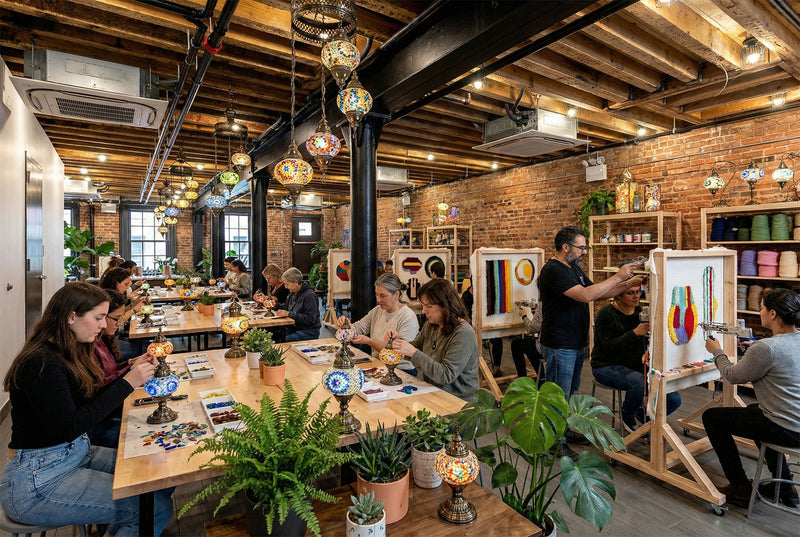
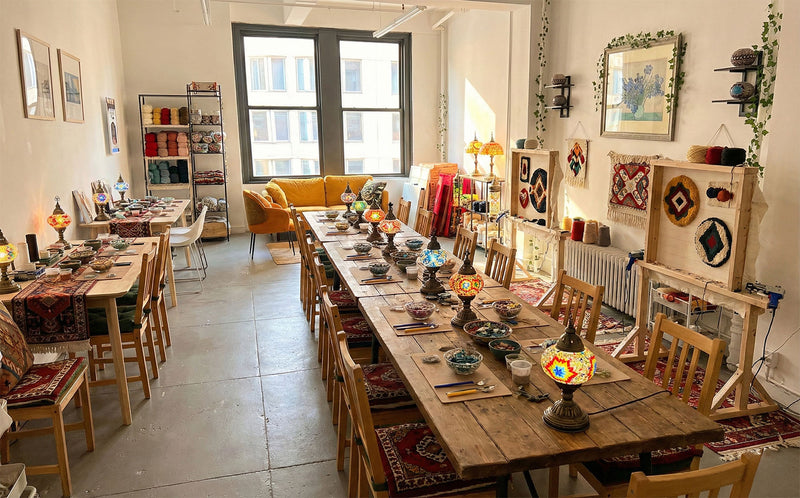
Full disclosure, this one is ours. We run two San Francisco studios: SoMa at 360 Ritch Street, a short walk from Montgomery BART, and the Financial District at 405 Sansome Street, which is steps from Embarcadero BART and therefore about as rain-proof as an arrival gets in this city.
You sit down and make something over a couple of hours: a tufted rug, a Turkish mosaic lamp, a terrarium, a soy candle, moss wall art. The Financial District studio also runs perfume making, woodburning and Turkish water marbling. It is fully indoors, it suits both adults and kids depending on the workshop, and you leave with the thing you made rather than a photo of it. Sessions are booked in advance and wet weekends fill up, so check availability before heading over. Around two hours.

What Not to Plan on a Wet Day
Some of San Francisco's best-known attractions are poor rain choices, and it is worth knowing which before you spend money on them.
Alcatraz is the big one. The cellhouse audio tour is indoors and is arguably better in bad weather, when a cold wet island feels closer to the real thing. But the walk up from the dock is a steep outdoor climb with no shelter, the grounds are exposed, and there is no food service on the island, so there is nowhere to retreat to when a squall comes through. The genuine risk is not rain but wind, because that is what cancels the ferry. Go in light rain with a hooded jacket; do not treat it as your rainy day plan.
The Japanese Tea Garden is beautiful in mist and useless in a storm. Moss, stone and water all look better wet, and the crowds vanish, but the covered footprint is essentially the tea house and the gift shop. In an atmospheric river you will be soaked within ten minutes.
The Legion of Honor is a fine museum with a miserable approach. It sits on an exposed bluff in Lincoln Park and is one of the windiest spots in the city, with the weakest transit connection on this list. Lovely once you are inside, if you can get there without walking fifteen minutes into horizontal rain.
If You Are Stuck in One Part of the City
Downtown, SoMa or the Embarcadero
The strongest position to be in. SFMOMA, the Children's Creativity Museum, the Ferry Building, our two studios and the Civic Center pair are all here, and BART links most of them with minimal time outside. If you are staying downtown you do not need a car or a plan.
The Richmond or the Sunset
Head for Golden Gate Park and the Music Concourse. The Academy of Sciences and the de Young are the two biggest indoor spaces on this side of the city and they are next door to each other. This is also the foggiest part of San Francisco in summer, so if it is grey rather than wet, consider going east instead.
Fisherman's Wharf
Thinner than it used to be. Musée Mécanique is the genuine one. Be aware that Madame Tussauds closed in 2024 and the San Francisco Dungeon never reopened after the pandemic, and both still appear on published rainy-day lists. If the Wharf disappoints, the Cable Car Museum is a short ride up the hill and free.
The Mission or the Castro
The sunniest and driest corner of the city in summer, and the best place to eat in any weather. For indoor attractions specifically you are better heading downtown, but the Randall Museum sits just above the Castro and the restored Castro Theatre is a few blocks away.
What About the Evening?
Rain matters less after dark, when most of what you would be doing is indoors anyway. The Castro Theatre reopened in February 2026 after a two-year, forty-one-million-dollar renovation and now runs a mix of films and live music, which makes a wet evening in the Castro a much better proposition than it was for the previous two years. The Exploratorium's Thursday After Dark is the adults-only version of the same idea.
Evening workshops work for the same reason. You are not giving up daylight to sit inside, which makes it an easy thing to add to a day the weather has already interrupted.
When Does It Actually Rain in San Francisco?
Almost entirely between November and March. Those five months account for roughly eighty-five per cent of the city's annual rainfall, and December, January and February alone deliver more than half of it. San Francisco averages somewhere around twenty-three inches a year across about seventy rainy days.

The summer is genuinely dry. July averages a hundredth of an inch of rain and roughly one rainy day every ten years' worth of Julys. If you are visiting between June and August, you will almost certainly not see rain. You will see fog, and you should pack for it, because the two get confused constantly and only one of them requires an indoor plan.
The other thing to know is that annual totals swing wildly here. The city has recorded years under nine inches and years over forty-nine. An average is a poor guide to any particular winter.
Quick Answers
Does it rain a lot in San Francisco?
Less than most people expect in total, but concentrated. Around twenty-three inches a year, nearly all of it between November and March. Summer is close to rainless.
Is fog the same as rain in San Francisco?
No, and confusing the two is the most common visitor mistake. Fog is a summer phenomenon caused by cold Pacific water meeting hot inland air, and it usually clears back toward the coast by early afternoon. It can leave you damp but it does not close anything, and it does not fall on the whole city at once the way winter rain does.
Can I drive somewhere else in the city to escape the rain?
In winter, no. Atmospheric river storms cover the entire Bay Area at once. In summer, yes, but you are escaping fog and wind rather than rain, and moving east from the coast usually does it.
What should I pack for rain in San Francisco?
A hooded waterproof jacket rather than an umbrella. Winter storms come with sustained wind that turns umbrellas inside out, and locals almost universally use hoods instead. Layers matter more than a heavy coat, because you will move between fifty-five degrees outside and warm indoors repeatedly. Waterproof shoes are worth more than you think.
What is the best rainy day activity in San Francisco with kids?
The California Academy of Sciences if you want one place to absorb the whole day, and the Exploratorium if your children are old enough to want to touch everything. If you would rather not spend a lot, the Randall Museum and the Cable Car Museum are both free and both genuinely good.
Which museums are closed on which days?
This trips up more rainy days than anything else. SFMOMA is closed Wednesdays. The Asian Art Museum is closed Tuesdays and Wednesdays. The de Young and the Legion of Honor are closed Mondays. The Exploratorium and the Cable Car Museum are closed Mondays. The Conservatory of Flowers is closed Wednesdays. The California Academy of Sciences is open every day of the year, which is why it is the safe default.
Is Alcatraz cancelled when it rains?
Not usually. Tours generally run in rain, and what actually cancels sailings is wind and sea state rather than precipitation. Check with the ferry operator directly rather than assuming, and book well ahead in any season because it sells out.
Do I need a car for any of this?
No for downtown, SoMa, Civic Center and the Embarcadero, all of which BART covers well. Golden Gate Park is reachable by Muni but slower. The Randall Museum and the Legion of Honor are the two that genuinely reward driving or a rideshare in bad weather.
Is San Francisco worth visiting in winter?
Yes. Winter brings the rain but also the clearest air, the greenest hills and far smaller crowds at everything on this list. You just want two or three indoor plans held in reserve rather than a schedule that assumes sunshine.
The Short Version
If it is winter and it is raining, do not wait it out, because it will not pass. Pick one large indoor thing and one meal, and let the day be that. Golden Gate Park and the SoMa and Civic Center clusters each hold enough to fill a full day without a real journey between stops.
If it is summer and it is grey, you are probably looking at fog rather than rain. Move east before you give up on the day, and if it is still miserable, go and make something instead.